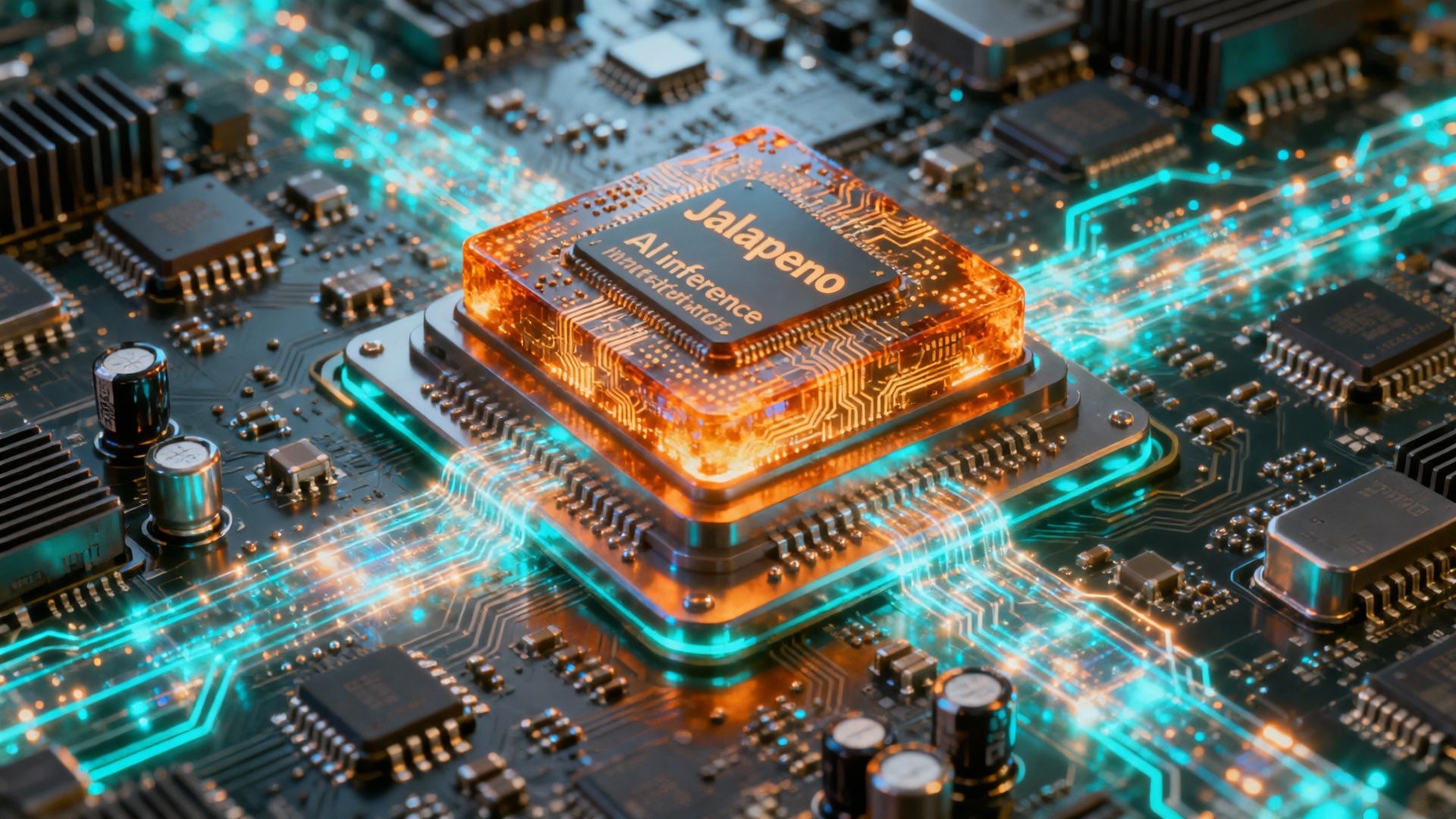
AI Daily Digest August 26, 2026: OpenAI Unveils Custom Jalapeño Chip, Claude Syncs Chat and Cowork Memory
- Ai daily
- August 26, 2026
Table of Contents
Good morning, engineers, researchers, and technology leaders! The AI Daily Digest for August 26, 2026, highlights seismic shifts across the artificial intelligence landscape, from next-generation custom inference silicon to unified persistent agent memory and agent-native web infrastructure. We begin today with a stunning revelation at the Hot Chips conference: OpenAI officially unveiled “Jalapeño,” its first proprietary in-house inference chip, demonstrating token throughput and power efficiency metrics that outpace both Nvidia’s Blackwell and Rubin architectures. In enterprise and productivity tooling, Anthropic resolves a long-standing workflow friction by bridging shared persistent memory seamlessly between Claude Chat and Claude Cowork. Meanwhile, Meta prepares to enter the commercial autonomous agent space with “Hatch” alongside a new foundation model codenamed “Watermelon” this fall, Google Cloud introduces Gemini Enterprise for Legal with native Model Context Protocol (MCP) integrations, and venture-backed startup Keenable emerges from stealth with $26 million to build a dedicated real-time search index tailored exclusively for autonomous AI agents. Let’s dive straight into the top five stories shaping the AI landscape today!
🌶️ OpenAI Unveils First Custom Inference Chip “Jalapeño”: Outperforming Nvidia Blackwell and Rubin
At the prestigious Hot Chips semiconductor symposium, OpenAI sent shockwaves through the industry by revealing technical specifications and benchmark results for “Jalapeño” - its first custom-designed silicon processor engineered specifically for large-scale model inference. Independent evaluations conducted by SemiAnalysis across the InferenceX benchmark suite show that Jalapeño achieves substantially higher token generation rates per user and superior throughput per kilowatt compared to prevailing commercial accelerators, surpassing both Nvidia’s flagship Blackwell and emerging Rubin architectures.
Developing proprietary silicon represents a pivotal strategic milestone for OpenAI as it seeks to reduce dependence on Nvidia’s hardware pricing and supply constraints. With daily inference workloads scaling to hundreds of millions of user queries across ChatGPT and enterprise developer APIs, operational power consumption and compute unit economics have become paramount constraints. By tailoring Jalapeño’s instruction set directly to multi-step reasoning architectures and Transformer attention patterns, OpenAI aims to dramatically reduce per-token serving costs while enabling real-time, low-latency agentic interactions at global scale.
Source: The Decoder
🧠 Claude Cowork Gains Unified Shared Memory Across Chat and Collaborative Workspaces
Anthropic has introduced a major productivity enhancement across its ecosystem by deploying a shared persistent memory layer connecting Claude Chat and Claude Cowork. Previously, users collaborating across both interfaces frequently encountered context fragmentation, requiring repetitive briefings regarding project objectives, codebase conventions, architectural preferences, and individual workflow constraints whenever transitioning between chat sessions and collaborative workspaces.
With the unified memory architecture, Claude continuously updates and references cross-session background knowledge, active project files, and user instructions without polluting the immediate context window. This continuous synchronization transforms Claude from an episodic conversational assistant into a persistent digital colleague that retains institutional context, understands organizational norms, and accelerates technical collaboration for engineering teams and enterprise knowledge workers.
Source: TechCrunch
🤖 Meta Prepares Launch of Paid Autonomous Agent “Hatch” and Next-Gen “Watermelon” Model
Meta Platforms is gearing up to launch its first paid autonomous agent service, dubbed “Hatch,” within the coming weeks, while simultaneously preparing to release an advanced foundation model codenamed “Watermelon” in October 2026. The rollout signals an aggressive commercialization strategy from Meta, building upon the widespread developer adoption of its open-weight Llama family by introducing premium, hosted agent capabilities for consumers and businesses.
Hatch is designed to execute multi-step autonomous workflows, encompassing business process automation, cross-platform customer lifecycle management across WhatsApp, Instagram, and Messenger, as well as complex software development assistance. Paired with the Watermelon model - which is reportedly specialized in multi-hop causal reasoning and precise tool-calling orchestration - Meta is positioning itself to compete directly against paid enterprise agent suites from OpenAI, Google, and Microsoft.
Source: The Decoder
⚖️ Google Launches Gemini Enterprise for Legal with Native Model Context Protocol (MCP) Connectors
Google Cloud has rolled out Gemini Enterprise for Legal, a specialized enterprise suite tailored for law firms, corporate legal departments, and compliance teams. A key architectural highlight of the platform is its out-of-the-box interoperability with mission-critical legal infrastructure - including document management system iManage, electronic agreement platform DocuSign, and e-discovery leader Everlaw - powered by standardized Model Context Protocol (MCP) connectors.
In partnership with global advisory firms including Deloitte, the platform automates complex contractual risk assessments, statutory compliance cross-checks, case law synthesis, and litigation brief drafting while upholding rigorous evidentiary standards. Google’s enterprise adoption of MCP demonstrates how open context-sharing protocols are emerging as industry standards, enabling generative models to interface securely with sensitive on-premises and cloud repositories without risking data leakage or client confidentiality breaches.
Source: The Decoder
🌐 Keenable Exits Stealth with $26M Seed to Build Dedicated Web Search Index for AI Agents
Artificial intelligence startup Keenable has emerged from stealth mode with $26 million in seed funding led by venture capital firm Accel. Rather than constructing a consumer-facing search engine designed for human visual browsing in web browsers, Keenable is addressing an infrastructure bottleneck: building an expansive, real-time web index engineered entirely for machine ingestion and programmatic querying by autonomous AI agents.
Standard web search engines return markup-heavy HTML, invasive tracking scripts, and display advertising that inflate token budgets and induce hallucinations in autonomous agents. Keenable provides low-latency APIs delivering structured, clean semantic data optimized for agentic reasoning loops, verification subroutines, and rapid tool execution. The substantial funding round highlights the emergence of an “agent-native web,” where digital information is systematically indexed and served to satisfy the requirements of autonomous software agents operating worldwide.
Source: TechCrunch