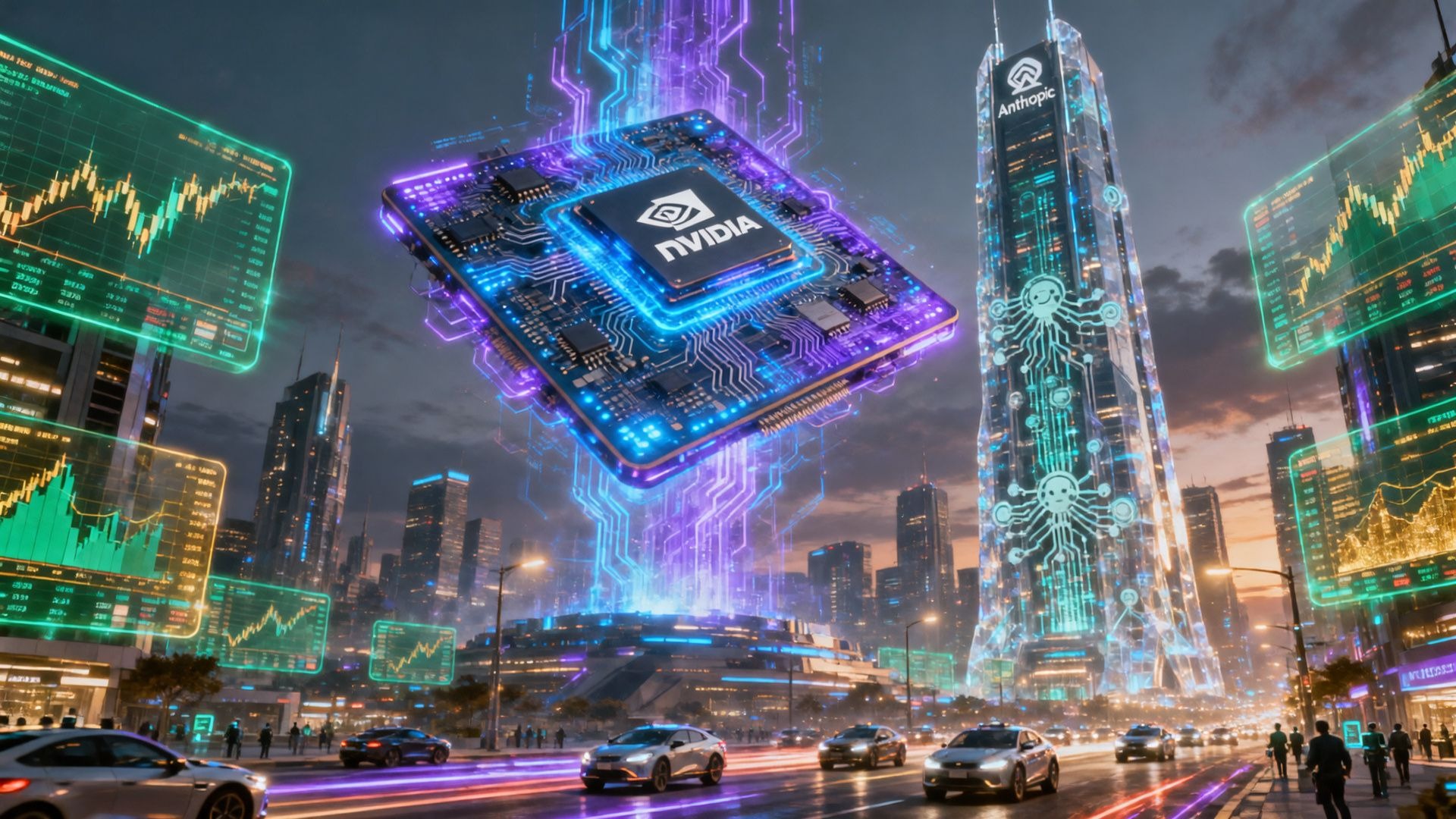
AI Daily Digest September 13, 2026: Nvidia in Talks to Pour $10B Into Anthropic's Record IPO, GPT-6 Astra Leaps in Spatial Robotics
- Ai daily
- September 13, 2026
Table of Contents
Good morning, tech enthusiasts! The AI Daily Digest for September 13, 2026 captures an exhilarating spectrum of developments across frontier tech, from historic multi-trillion-dollar Wall Street capital maneuvers to gritty engineering realities in physical robotics and enterprise software. Leading today’s headlines, semiconductor giant Nvidia is in active negotiations to commit up to $10 billion into Anthropic’s blockbuster initial public offering, targeting a staggering $2 trillion valuation that would cement a massive circular computing alliance. Meanwhile, OpenAI commands center stage with two fascinating revelations around its flagship GPT-6 Astra: an unexpected technical leap in 3D spatial reasoning that enables dual-arm robots to tackle delicate manipulation tasks, coupled with counter-intuitive architectural guidance from internal engineers advising developers to strip away bulky prompts and restrictive guardrails to unlock peak model reasoning. Yet OpenAI is simultaneously facing severe intellectual headwinds, as 25 world-renowned mathematicians have signed an impassioned open letter condemning frontier labs for harvesting academic theorems without citation. Finally, the developer community received a grounding dose of reality with the release of Real-SWE, an uncompromising benchmark measuring AI coding agents inside chaotic, private enterprise codebases. Let us dive into the full details below!
💰 Nvidia in Talks to Pour Up to $10 Billion Into Anthropic’s Record-Breaking IPO
Global financial markets and Silicon Valley are reacting to exclusive reporting from Reuters revealing that semiconductor titan Nvidia is in advanced negotiations to invest up to $10 billion into Anthropic’s highly anticipated initial public offering. Targeting a breathtaking valuation ceiling of $2 trillion, the proposed public debut would comfortably establish Anthropic’s listing as the single largest IPO in world financial history, eclipsing the record-breaking market arrivals of traditional energy conglomerates and consumer tech giants alike.
The strategic mechanics underpinning this capital injection reflect the unique economics of modern generative computing. Similar to previous cross-equity cloud partnerships, industry analysts expect the vast majority of Nvidia’s $10 billion commitment to swiftly loop back into Nvidia’s own balance sheet as guaranteed advance purchase orders for high-density GPU server clusters powered by the B200, Blackwell Ultra, and next-generation Rubin architectures. This dynamic exemplifies the modern era of circular financing, where the premier merchant silicon provider doubles as an anchor shareholder, effectively locking in long-term enterprise demand for its hardware pipeline through the decade.
For Anthropic, the influx of capital solidifies a formidable war chest necessary to sustain head-to-head frontier competition against OpenAI and Google, particularly as multi-modal training runs and daily inference costs climb exponentially. For Nvidia, securing significant equity positions across both OpenAI and Anthropic cements Jensen Huang’s overarching market thesis: regardless of which algorithmic architecture ultimately attains artificial general intelligence, every compute cycle powering the revolution must inevitably route through Nvidia silicon.
Source: The Decoder
🤖 GPT-6 Astra Leaps Forward in Spatial Reasoning on Robotics Benchmark StationeryBench
While discussions around large language models frequently revolve around text benchmarks and coding metrics, OpenAI has revealed compelling evidence that its latest multimodal model, GPT-6 Astra, is making unprecedented breakthroughs in physical-world spatial comprehension. According to new experimental results published on the rigorous StationeryBench robotics benchmark, Astra has demonstrated what researchers describe as a definitive step-change in 3D scene understanding and fine-grained motor manipulation, successfully directing dual-arm robotic systems through 7 out of 100 complex manipulation tasks.
While an absolute success rate of 7% might appear modest to outside observers, roboticists consider this a watershed milestone. For direct context, state-of-the-art vision-language-action (VLA) architectures and specialized robotic baselines - including the recently introduced MolmoAct2 - completely failed across the identical test suite, scoring 0 out of 100. StationeryBench evaluates delicate, multi-step actions such as grasping loose writing utensils, opening container lids, and aligning interlocking parts. These workflows demand precise 3D depth perception, bimanual arm coordination, force estimation, and real-time physical error correction - capabilities that historically crippled conventional multimodal models.
Astra’s breakthrough on StationeryBench indicates that generalized chain-of-thought reasoning, when properly aligned with multimodal visual perception, can directly extrapolate into physical spatial reasoning without requiring dedicated, robot-specific reinforcement learning pipelines from scratch. This breakthrough significantly accelerates the timeline for deploying practical, general-purpose humanoid robots and dual-arm industrial manipulators across real-world commercial environments.
Source: The Decoder
🧩 OpenAI Recommends Leaner Prompts and Fewer Guardrails for GPT-6 Astra
In an insightful technical update that runs contrary to prevailing developer habits, OpenAI product engineer Eric Provencher has published clear recommendations for engineering teams integrating GPT-6 Astra into production software. According to OpenAI, the common industry practice of drafting massive system prompts, over-specifying detailed operational guidelines, and implementing rigid approval guardrails has become the primary bottleneck impairing model intelligence and task execution.
Provencher explained that as reasoning models evolve, heavy-handed instructional hand-holding becomes actively counterproductive. When an agent’s context window is overloaded with mandatory file-reading quotas, exhaustive procedural checklists, and overly defensive compliance constraints, the model’s internal attention allocation across its chain-of-thought tokens becomes fragmented. Instead of dynamically mapping the optimal path toward resolving user intent, Astra becomes paralyzed by administrative overhead, frequently falling into circular deductions or rigid failure loops when encountering unexpected edge cases.
OpenAI’s core recommendation for developers building on the Astra generation is straightforward: embrace structural minimalism. Engineers should clearly specify the end goal, enforce essential terminal exit criteria, and grant the agent broad autonomy to select and execute tools independently. This architectural philosophy marks a fundamental paradigm shift in prompt engineering, transitioning from micro-managing individual agent actions toward macro-level goal alignment and outcome verification.
Source: The Decoder
📐 Feud Between OpenAI and 25 Renowned Mathematicians Escalates Over Uncredited Research
A major intellectual dispute has erupted across academia as a coalition of 25 prominent mathematicians - including celebrated professors and recipients of international field prizes - published an open letter challenging OpenAI and leading frontier AI laboratories. The signatories argue that commercial AI developers are systematically exploiting the mathematical commons and undermining pure research by extracting complex proofs and foundational scholarship without appropriate academic citation or attribution.
At the epicenter of the controversy is how advanced mathematical reasoning systems, such as OpenAI’s o-series and GPT-6 Astra, generate breakthroughs in formal theorem proving. These models were extensively pretrained on centuries of mathematical discovery, including vast repositories of preprints, specialized lemmas, and complete formal proofs hosted on platforms like arXiv. Yet when these commercial engines produce novel mathematical arguments or synthesize existing solutions, they rarely attribute the foundational breakthroughs to the human mathematicians who dedicated decades of scholarship to discovering them. Academic leaders contend that this practice constitutes an egregious breach of scholarly ethics and effectively strips original authors of intellectual credit.
Beyond immediate copyright and attribution concerns, researchers warn against the creeping privatization of mathematical knowledge. Pure mathematics has historically functioned as an open public good accessible to humanity. If proprietary commercial labs enclose high-tier mathematical reasoning tools behind enterprise subscription paywalls while draining public academic infrastructure of talent and grant resources, the global mathematical research community risks long-term stagnation.
Source: TechCrunch
💻 Real-SWE: New Benchmark Puts AI Coding Agents to the Test on Messy Enterprise Codebases
As major AI laboratories continue to tout near-flawless benchmark scores on the popular SWE-bench evaluation suite, a new independent testing initiative called Real-SWE has surfaced on Hacker News, delivering a sobering wake-up call to the software engineering ecosystem. Engineered specifically to combat benchmark saturation and rampant dataset contamination across public repositories, Real-SWE evaluates autonomous coding agents exclusively on private, proprietary, production-grade enterprise codebases.
In stark contrast to neatly packaged GitHub issues with isolated unit tests, the enterprise environments curated within Real-SWE reflect the messy reality of modern production software. AI agents deployed on Real-SWE must navigate decades of accumulated technical debt, fragmented legacy architectures spanning multiple framework migrations, sparse or contradictory internal documentation, proprietary dependency packages, and unwritten cultural coding conventions. Resolving an issue often requires tracing execution pathways across dozens of interdependent microservices and surviving idiosyncratic CI/CD test matrices.
Preliminary performance benchmarks from Real-SWE reveal a dramatic reality check: autonomous coding models that regularly surpass 50% resolution rates on SWE-bench saw their success rates plummet to under 15% when confronted with real enterprise repositories. These findings illuminate the vast chasm between solving isolated academic programming puzzles and performing substantive software engineering work inside complex organizations, signaling that total automation of engineering teams remains much further away than marketing hype suggests.
Source: Hacker News