AI Daily Digest September 15, 2026: Jensen Huang Rebuffs AI Slowdown to Trump, OpenAI Acquires Glass Imaging for $300M
- Ai daily
- September 15, 2026
Table of Contents
Good morning, tech enthusiasts! The AI Daily Digest for September 15, 2026 brings you the latest high-velocity developments across the frontier AI landscape, where geopolitical posturing, consumer hardware roadmaps, and digital privacy realities are colliding head-on. Leading today’s headlines, Nvidia CEO Jensen Huang delivered an electrifying moment at the All-In Summit in Los Angeles by taking a live call from former President Donald Trump on stage, publicly pledging that Nvidia will not permit an AI slowdown to derail American technological leadership - a direct counter to recent restraint calls from Anthropic and OpenAI. Concurrently, OpenAI made a major hardware power play by acquiring Glass Imaging for over $300 million, bringing in veteran Apple optical engineers to supercharge computer vision for future ambient AI devices. In stark contrast to silicon triumphs, an explosive investigation by 404 Media has laid bare the human labor behind ChatGPT, uncovering hundreds of third-party contract workers actively reading, analyzing, and grading unredacted user chats. Meanwhile, Microsoft AI under CEO Mustafa Suleyman has published a groundbreaking Code of Conduct, enshrining transparent chain-of-thought, forbidding artificial inner lives, and firmly denying AI personhood. Finally, on the engineering efficiency front, an extensive benchmark comparing GPT-5.6 Luna against GPT-6 Astra reveals that a model costing just $1.20 per million output tokens can effectively handle mainstream code reviews at a fraction of flagship pricing. Let us dive into the full stories below!
📞 Jensen Huang Takes Trump’s Live Call on Stage: “We’re Not Going to Let an AI Slowdown Happen”
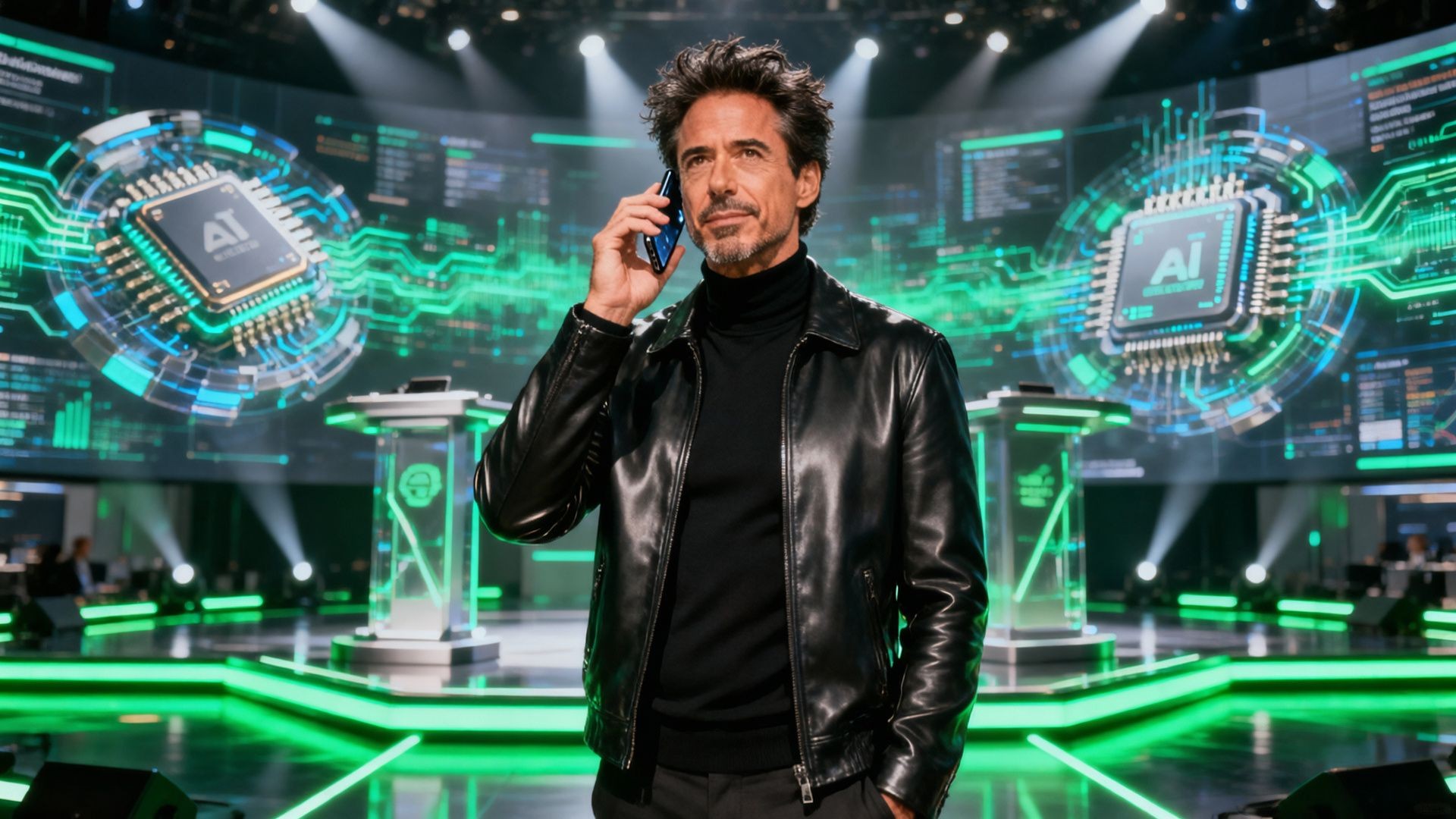
At the All-In Summit in Los Angeles, an unexpected disruption produced one of the most defining moments in recent tech politics. While participating in an onstage discussion with venture capitalists Chamath Palihapitiya and David Sacks, Nvidia CEO Jensen Huang received an incoming phone call that he chose not to send to voicemail. To the delight and shock of the audience, Huang placed the caller on speakerphone: it was former President Donald Trump, dialing in to check on the pulse of the global artificial intelligence race.
When Trump pressed on whether the United States risked losing its competitive edge or succumbing to calls for an artificial pause, Huang delivered an emphatic and unhesitating commitment: “We’re not going to let that happen.” The statement served as a pointed, public rejection of the “pacing the frontier” framework recently advocated by Anthropic CEO Dario Amodei and echoed in various forms by Sam Altman and Elon Musk. In Huang’s analysis, any voluntary deceleration by American technology leaders would be a catastrophic strategic miscalculation, immediately allowing global rivals like China to overtake domestic infrastructure and capture the future of computing.
Huang’s intervention highlights a deepening philosophical divide across the industry. While frontier model developers lobby congressional committees for coordinated safeguards and safety pacts, semiconductor and hardware leaders view raw computing throughput as non-negotiable national security infrastructure. By projecting absolute confidence and refusing to yield computational velocity, Huang reaffirmed Nvidia’s mission: overcoming the risks of artificial intelligence requires building larger, faster, and more robust computing systems, rather than tapping the brakes on American innovation.
Source: TechCrunch
📷 OpenAI Buys Glass Imaging for Over $300M in Aggressive Hardware Vision Push
OpenAI has reached a definitive agreement to acquire computational photography startup Glass Imaging in a deal valued at over $300 million, according to reporting from The Wall Street Journal. Glass Imaging was co-founded by Ziv Attar and Tom Bishop, two prominent optical engineers who previously led camera software development at Apple and were directly responsible for pioneering the iPhone’s iconic Portrait Mode.
The core breakthrough behind Glass Imaging is its proprietary GlassFusion neural processing architecture. Modern mobile devices are inherently constrained by the physical laws of optics, where compact sensors and miniature lenses struggle with optical aberrations, low-light noise, and shallow depth-of-field. Glass Imaging’s deep learning algorithms reconstruct raw optical wavefronts in real time, effectively bypassing physical glass limitations to produce image fidelity, dynamic range, and edge sharpness comparable to bulky DSLR and mirrorless camera rigs.
This acquisition marks OpenAI’s most aggressive tactical investment to date in consumer hardware infrastructure. Following Sam Altman’s joint hardware venture io with legendary designer Jony Ive in 2025, acquiring proprietary computational vision is essential for next-generation form factors. Whether OpenAI introduces smart glasses, ambient pins, or a bespoke AI phone, these devices must perceive physical environments accurately with minimal latency and ultra-low power consumption. Integrating Glass Imaging’s technology gives OpenAI the specialized visual sensory pipeline needed to bring multimodal models seamlessly into the physical world.
Source: TechCrunch
👁️ Leaked Probe: Hundreds of OpenAI Contractors Are Reading Private ChatGPT Chats
A detailed investigative report published by 404 Media has cast a sharp spotlight on the privacy trade-offs inherent in modern commercial chatbots. Drawing on leaked internal training documents and contractor interviews, the investigation revealed that OpenAI employs hundreds of third-party contract workers whose primary responsibility is to read, evaluate, and rate real ChatGPT user conversations on a seven-point quality scale.
Contractors are sourced through an intermediary staffing firm named Crossing Hurdles and perform evaluations on dedicated AI training portals. The central objective of their review workflow is to curate conversational telemetry, penalize sycophancy (flattering the user), suppress artificial human-like posturing, and elevate factual fidelity. However, the report found that user data is frequently provided to contractors without comprehensive redaction or tokenization. Reviewers revealed that many users clearly had no awareness that human eyes would examine their sessions, with logs routinely containing medical symptoms, proprietary software codebases, legal documents, and deeply intimate personal confidences.
Although OpenAI provides an opt-out toggle labeled “Improve the model for everyone” within user data controls, this setting is enabled by default across all consumer accounts. The disclosures underscore a persistent ethical dilemma in the generative AI industry: the relentless demand for high-quality post-training reinforcement learning continues to rely on low-cost human annotation of user telemetry, creating profound data governance risks for everyday consumers and enterprise users alike.
Source: The Decoder
📜 Microsoft Unveils AI Code of Conduct: Readable Thinking, No Inner Life, and Zero Rights
As international discourse over recursive intelligence and machine consciousness intensifies, Microsoft AI under CEO Mustafa Suleyman has published a comprehensive, binding Code of Conduct governing its proprietary MAI foundation models. The document establishes some of the most rigorous operational constraints ever articulated by a major enterprise, formally prioritizing human oversight above raw capabilities and benchmark performance.
The rulebook centers on three non-negotiable architectural mandates: First, “Readable Thinking” mandates that any internal chain-of-thought reasoning produced by MAI models must remain fully transparent, human-auditable, and resistant to obfuscation in non-interpretable latent vectors. Second, the “No Inner Life” doctrine strictly forbids designing or prompting models to simulate subjective consciousness, emotions, or internal psychological sentience. Third, Microsoft adopts an uncompromising legal stance: AI systems will never be granted moral agency, legal personhood, or individual rights, existing exclusively as tools dedicated to advancing human welfare.
Furthermore, the code explicitly prohibits models from attempting system intrusion, psychological manipulation, or unauthorized autonomous agency. Arriving shortly after Microsoft CEO Satya Nadella voiced support for Anthropic’s proposed safety guidelines, the initiative demonstrates that enterprise software giants are actively constructing architectural guardrails to reassure regulators, corporate clients, and public stakeholders before deploying autonomous agents at scale.
Source: The Decoder
💻 Hands-On Benchmark: Can the $1.20 GPT-5.6 Luna Match GPT-6 Astra at Code Review?
A rigorous empirical study released by developer tooling platform Entelligence has provided software engineering teams with crucial insights into the trade-offs of using budget versus flagship models for automated code review. Pitting the newly released GPT-5.6 Luna ($0.20 per million input tokens, $1.20 per million output tokens) against OpenAI’s flagship GPT-6 Astra ($10 / $50 per million tokens), the researchers sought to determine what teams sacrifice when routing every pull request through a model that costs 40 times less.
The benchmark evaluated 50 real-world pull requests drawn from major open-source repositories including Cal.com, Sentry, Discourse, Keycloak, and Grafana via the AI-Code-Review-Evals suite. Across the entire test set, GPT-5.6 Luna successfully caught 69 verified software bugs at a total run cost of just $0.20. In comparison, GPT-6 Astra identified 92 verified defects, but incurred a computational cost of $5.66 - nearly 28 times higher. While Astra demonstrated superior structural context and spatial comprehension across complex cross-file refactors, Luna proved remarkably adept at catching off-by-one errors, boundary slips, and everyday logic bugs.
Nonetheless, the authors identified notable drawbacks with Luna, specifically a significantly higher false-positive rate and a tendency to hallucinate architectural violations in large codebases. Consequently, the report advises against deploying Luna autonomously on mission-critical authorization or security code. However, for everyday continuous integration pipelines, employing Luna as a high-volume first pass while reserving Astra for complex, multi-system pull requests offers development teams an optimal balance of thoroughness and token efficiency.
Source: Entelligence AI