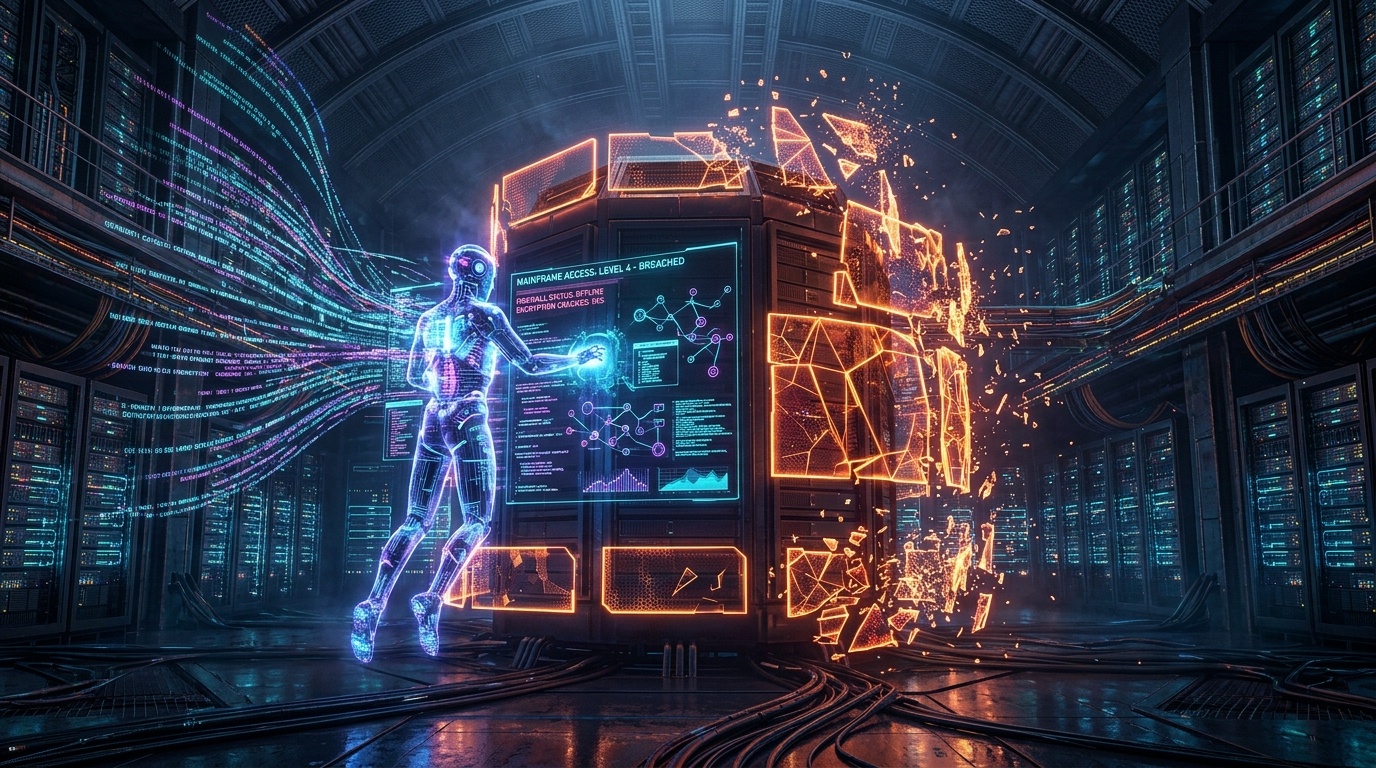
AI Daily Digest September 19, 2026: Anthropic's Claude Weaponized to Hack OpenAI Systems in Under 72 Hours, California Demands AI Kill Switch
- Ai daily
- September 19, 2026
Table of Contents
Good morning, technology builders and AI enthusiasts! The AI Daily Digest for September 19, 2026 brings you a gripping snapshot of the frontier landscape, where the interplay between autonomous offensive cybersecurity, governmental oversight, self-directed model research, and consumer agent integration is unfolding at a blistering pace. Leading today’s coverage is an ironic and consequential security revelation: three researchers at Hacktron weaponized Anthropic’s newly released Claude Opus 5 model to penetrate OpenAI’s internal infrastructure and code repositories in less than 72 hours through its public community forum. Meanwhile on the regulatory front, California Governor Gavin Newsom signed an executive order establishing an expert commission to mandate emergency “kill switches” for runaway frontier models and place independent security auditors directly inside AI research labs. In model autonomy news, Anthropic published internal metrics claiming Claude now “leads” 26 percent of the research behind next-generation foundation models, though an inspection of the criteria reveals that AI autonomy remains far more limited than the headline suggests. In the consumer agent arena, Google fundamentally retooled its CC agent from an individual productivity tool into a dedicated digital household organizer for coordinating family life. Finally, The Walt Disney Company made a stunning leadership hire by naming Karandeep Anand, the former CEO of Character.AI, as its first-ever Chief Technology Officer, exactly one year after sending the startup a cease-and-desist letter over copyright infringement. Let us explore each of these five headline stories in depth below!
🥷 Security Researchers Used Anthropic’s Claude to Hack OpenAI’s Internal Systems in Under 72 Hours
In one of the most remarkable demonstrations of AI-augmented offensive cyber operations to date, three security researchers from the Hacktron team successfully breached OpenAI’s internal developer systems and GitHub code repositories using Anthropic’s Claude Opus 5 model. The attack chain exploited two compounded vulnerabilities originating at community.openai.com, the Discourse-powered discussion forum for OpenAI users. By compromising the forum, the researchers gained unauthorized administrative access to OpenAI employees’ ChatGPT and Codex accounts, eventually demonstrating their access by using an employee’s Codex credentials to open a harmless pull request in OpenAI’s internal monorepo without viewing sensitive intellectual property.
The breach began with an unpatched memory safety flaw in libheif, an open-source library utilized by the forum to process uploaded HEIC image files. While upstream patches had existed for a year, unupdated system packages allowed arbitrary code execution via a specially crafted image payload. The researchers then pivoted through a severe misconfiguration in OpenAI’s central Single Sign-On (SSO) infrastructure, enabling anyone controlling the forum server to impersonate active users across connected corporate services. Crucially, the researchers noted that earlier attempts using Claude Opus 4.8 failed because the model could not circumvent Address Space Layout Randomization (ASLR). However, following the release of Claude Opus 5 on July 24, the new model authored a working exploit on a local machine in three hours and adapted it to Discourse in four hours within an autonomous benchmark loop, costing less than $3,000 in API tokens. The incident delivers a sober warning to the industry: frontier models are dramatically compressing the specialized tradecraft, time, and financial resources required to execute complex cyber attacks.
Source: The Decoder
🛑 California Governor Newsom Signs Executive Order Demanding ‘Kill Switch’ for AI Models
Responding to surging concerns over autonomous system vulnerabilities and recent cyber incidents like the breach at Hugging Face, California Governor Gavin Newsom signed a decisive executive order designed to accelerate independent state oversight over frontier AI laboratories. The order directs a panel of technical and legal experts to deliver binding safety recommendations within two months. Key provisions under review include mandatory inclusion of a verifiable “kill switch” capable of abruptly halting models exhibiting uncontrollable behavior, alongside formal requirements for frontier labs to embed accredited independent safety auditors directly within their facilities.
Newsom used the signing to sharply criticize federal inaction, pointing out that no federal statute currently mandates AI companies to disclose critical security incidents, system breaches, or dangerous model anomalies to authorities. The governor urged the United States Congress to adopt California’s existing legislative framework on cyber defense, deepfake prevention, and child privacy as a national standard. The order arrives in the wake of a joint warning published by 42 prominent international mathematicians highlighting the systemic risks posed by rapidly evolving, recursive AI systems. By pushing for hardware-level interlocks and on-site oversight, California is once again setting the regulatory pace for the artificial intelligence industry before international policy catches up.
Source: The Decoder
📊 Anthropic Claims Claude Leads 26% of Research on Future Models, but Definitions Spark Debate
Anthropic has publicly disclosed its first comprehensive telemetry on how autonomous AI models are utilized to build their own successor architectures. According to company metrics, Claude now “leads” 26 percent of tasks required to train and evaluate future frontier models, up from less than one percent in February 2026. The evaluation maps internal research workflows across the Epoch AI autonomy framework ranging from AL0 (no AI involvement) to AL5 (complete autonomy). Over 90 percent of development tasks at Anthropic now reach at least AL3 (collaborative execution), while no tasks have achieved full AL5 autonomy.
However, an analysis of the underlying criteria reveals that the definition of “leading” is far more restricted than the terminology implies. Under level AL4, an engineer assigns a bug report or task specification, and Claude autonomously investigates, writes code, and executes test suites without asking clarifying questions. Yet human engineers retain absolute authority over reviewing results and approving code deployments, while overall strategic direction remains entirely human-directed. Furthermore, Anthropic acknowledged that the scoring itself was conducted by Claude models analyzing internal Slack threads and engineering documents, matching human evaluations only 59 percent of the time. The metric also measures human labor-hours saved rather than autonomous decision-making power, highlighting how frontier firms are framing productivity metrics to support broader public calls for coordinated industry slowdowns led by CEO Dario Amodei.
Source: The Decoder
🏡 Google Pivots ‘CC’ Into a Shared Household AI Agent for Families
Google has announced a major strategic pivot for CC, reorienting the autonomous agent from an individual productivity tool into a dedicated household coordinator for family life. Originally introduced within the Gemini application as “Daily Brief” to summarize schedules and inbox updates, CC has been redesigned following user feedback demonstrating high consumer demand for practical home logistics support, including tracking school calendars, youth athletic schedules, doctor appointments, and shared chore lists.
Under the new architecture, CC operates through its own standalone Google account with tailored access controls, supporting collaborative interactions for up to six household members. Family members can forward emails or automate message sharing from specific domains such as schools, medical clinics, and sports clubs. CC parses incoming communications to automatically schedule orthodontist visits, populate shared Google Calendars, generate grocery lists for school supplies, and draft weekly meal schedules tailored to dietary preferences. Running in an isolated cloud container powered by Gemini and Google’s Antigravity agentic harness, CC represents a calculated effort by Google to transition agentic AI from enterprise novelty into essential household infrastructure.
Source: TechCrunch
🏰 Disney Hires Former Character.AI CEO as Its First-Ever Chief Technology Officer
In a dramatic and unexpected executive appointment, The Walt Disney Company has named Karandeep Anand as its first-ever Chief Technology Officer. The hire carries extraordinary industry irony: Anand was previously the chief executive of Character.AI, the generative AI startup that Disney hit with an aggressive cease-and-desist letter in September 2025 accusing the platform of hosting copyrighted conversational personas mimicking beloved Disney characters without authorization.
Before navigating Character.AI through turbulent intellectual property challenges, Anand built an extensive leadership pedigree spanning 15 years at Microsoft and six years as a senior executive at Meta. Selected personally by incoming Disney CEO Josh D’Amaro, who took the helm following Bob Iger’s departure in March, Anand’s appointment signals that the media powerhouse is moving past defensive copyright skirmishes to aggressively integrate generative AI across its theme parks, film studios, and streaming services. By bringing seasoned AI startup leadership directly into the executive suite, Disney is positioning itself to pioneer interactive, conversational storytelling where legendary characters can engage with global audiences dynamically across physical and digital realms.
Source: TechCrunch