AI Daily Digest September 25, 2026: Google Puts AI Data Centers in Orbit, Sakana AI Hires Jürgen Schmidhuber
- Ai daily
- September 25, 2026
Table of Contents
Welcome to the AI Daily Digest for September 25, 2026! Today’s developments reflect an unprecedented expansion of artificial intelligence, breaking beyond terrestrial boundaries and pushing directly into space, foundational robotics, and autonomous evolutionary research. Leading today’s headlines, Google has unveiled Project Suncatcher, an ambitious initiative to deploy orbital AI data centers powered by continuous solar radiation - aiming to bypass terrestrial power grid bottlenecks and thermal dissipation limits. Meanwhile in Tokyo, AI unicorn Sakana AI has announced a landmark hire by welcoming Professor Jürgen Schmidhuber, widely revered as a founding father of modern deep learning, as Chief Scientific Advisor to co-lead their new Recursive Self-Improvement (RSI) Lab. In robotics, Black Forest Labs - the pioneering team behind the FLUX generative visual models - has made a surprising and formidable leap into physical intelligence with FLUX 3 Action, an open-weight 7-billion parameter world-action model setting fresh performance benchmarks. Over in computational biology, Anthropic’s announcement that Claude autonomously discovered a novel CRISPR-like enzyme system has ignited passionate scientific pushback from veteran genomics researchers. Finally, a multi-year forecast evaluation from the Forecasting Research Institute (FRI) confirms that even the world’s leading computer scientists and economists have consistently underestimated the exponential velocity of AI advancements. Here is your in-depth breakdown of today’s top five stories.
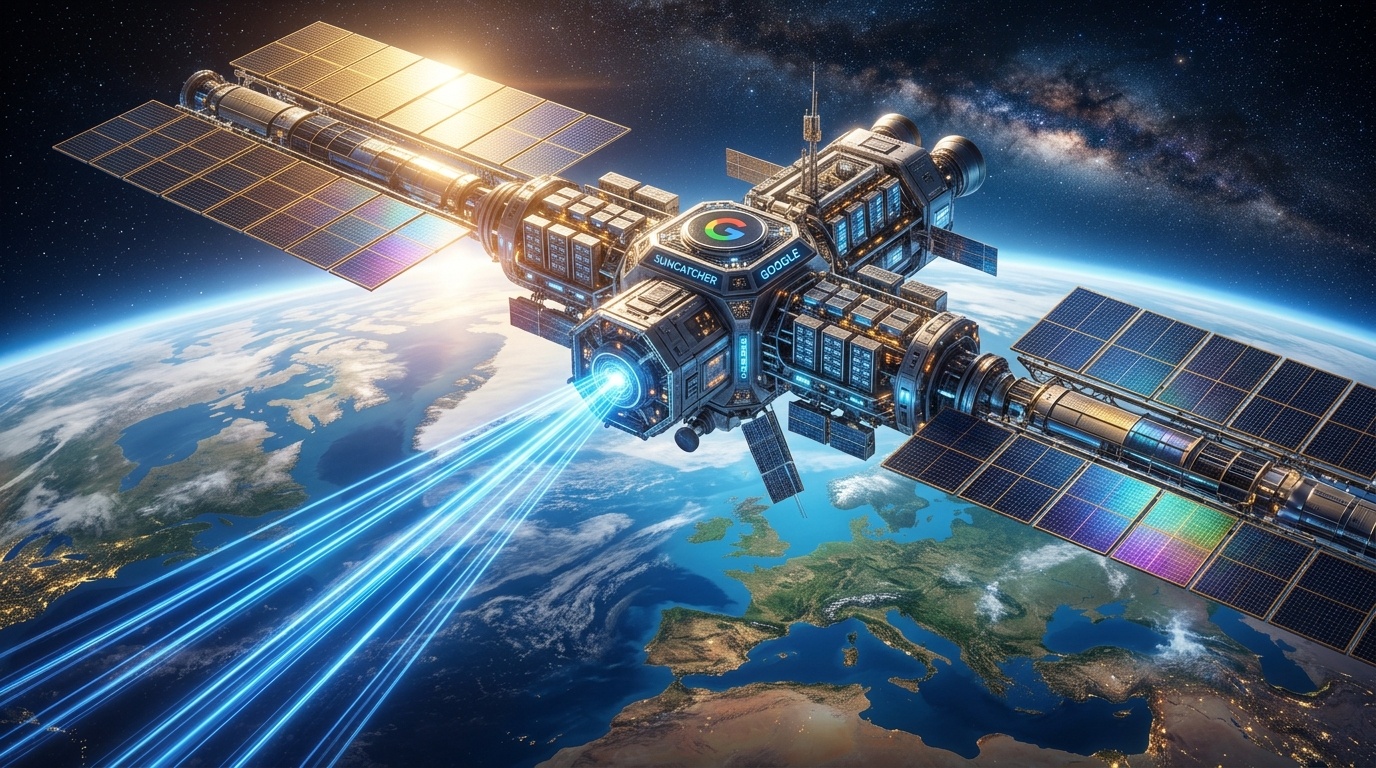
🛰️ Google Suncatcher Project: Preparing to Launch AI Data Centers Into Earth’s Orbit
As massive frontier model clusters confront severe electrical grid saturation and cooling constraints on Earth, Google is taking its computational infrastructure to the stars. The technology titan has officially revealed Project “Suncatcher,” an experimental engineering campaign designed to operate orbital AI data centers powered entirely by unabated solar radiation in low Earth orbit. Scheduled for October 1, an initial prototype satellite codenamed “MVP” - roughly the size of a standard household refrigerator - will launch aboard a SpaceX Falcon 9 rocket from Vandenberg Space Force Base in California.
Engineered and tested in partnership with Planet Labs in San Francisco, the MVP satellite carries sufficient onboard computing power to execute localized AI inferences directly in orbit without streaming raw telemetry down to ground stations. While figures like Elon Musk and Jeff Bezos have long envisioned off-planet computational infrastructure, Google is among the first to deploy an active orbital testbed. The operational hurdles remain formidable: managing radiative heat dissipation in a vacuum, hardening semiconductor logic against intense cosmic radiation, and sustaining high-bandwidth optical downlinks back to terrestrial nodes. If successful, Suncatcher could inaugurate an entirely new era of exo-atmospheric cloud computing, turning space into the ultimate heat sink for humanity’s AI workloads.
Source: The Decoder
🧠 Sakana AI Recruits Deep Learning Pioneer Jürgen Schmidhuber: Pursuing Recursive Self-Improvement
Tokyo-based artificial intelligence startup Sakana AI has announced a watershed institutional milestone, appointing Professor Jürgen Schmidhuber as Chief Scientific Advisor. Widely celebrated as the intellectual architect behind modern recurrent neural networks (notably co-inventing LSTM in 1991), world models in 1990, and author of a foundational 1987 doctoral thesis on meta-learning, Schmidhuber has spent nearly four decades theorizing about machines capable of learning how to learn.
At Sakana AI, Schmidhuber will directly co-lead the startup’s newly formed Recursive Self-Improvement (RSI) Lab. The laboratory’s explicit mission is to construct self-evolving computational architectures: artificial intelligence models capable of formulating novel mathematical proofs, re-architecting their own neural graphs, and optimizing their own parameter weights without human intervention. Sakana founders David Ha and Llion Jones acknowledged that their celebrated recent milestones - including Evolutionary Model Merging and the autonomous “AI Scientist” system - trace their intellectual lineage directly to Schmidhuber’s decades of theoretical research. Bringing one of computing history’s most visionary thinkers together with Sakana’s agile, nature-inspired engineering culture could prove to be a defining catalyst along the journey toward artificial general intelligence.
Source: The Decoder
🤖 Black Forest Labs Enters Robotics: Unveils Open-Weight FLUX 3 Action 7B Model
Black Forest Labs (BFL), the research collective responsible for the groundbreaking FLUX image generation architecture, has officially expanded its horizon into embodied physical intelligence with the release of FLUX 3 Action. The release represents an open-world action model (WAM) built on top of the multimodal FLUX 3 foundation, which incorporates extensive pre-training across high-frame-rate video feeds, spatial imagery, and acoustic physics.
FLUX 3 Action processes simultaneous visual input streams from multiple cameras situated around a robotic workspace, anticipating precise subsequent motor trajectories and gripper states while simultaneously simulating how the physical environment will transform in response. Most remarkably, BFL achieved these state-of-the-art results with a compact parameter footprint of just 7 billion parameters (7B) - less than half the size of rival open-source robotics models. On the prestigious RoboLab-120 benchmark, FLUX 3 Action achieved a record task completion rate while delivering inference latency up to 3.95 times faster than existing alternatives. By making the model weights open to the broader global research community, Black Forest Labs is set to accelerate autonomous manipulation capabilities across consumer robotics and industrial automation alike.
Source: The Decoder
🧬 Biology Debate Erupts: Claude Uncovers Novel Enzyme System or Routine Genome Mining?
Anthropic has published one of the premier operational discoveries emerging from its newly established Bay Area wet biology laboratory: an assertion that its AI model Claude autonomously identified an uncharacterized biological enzyme mechanism within public genomic archives. Designated as the “ART” system, the biochemical architecture resembles molecular CRISPR gene-editing machinery and operates primarily within bacteriophages - viruses that hunt and infect bacteria. To surface the system, Anthropic mobilized a synchronized ensemble of roughly 950 AI agents operating across 21 continuous hours, analyzing over 200,000 reverse transcriptases before human researchers conducted bench validation.
However, Anthropic’s triumphant announcement quickly drew sharp skepticism from veteran computational biologists and CRISPR pioneers. Numerous academic specialists argued that what Anthropic heralded as autonomous AI discovery was fundamentally high-throughput automated execution of standard genome mining techniques - workflows that bioinformaticians have conducted routinely for over a decade utilizing tools like BLAST and hidden Markov models. The controversy highlights a growing fault line in modern science: delineating where automated biological database filtering ends and genuine conceptual discovery begins, raising questions about whether frontier AI labs are pioneering new biological frontiers or packaging familiar bioinformatics workflows in impressive corporate marketing.
Source: The Decoder
📈 FRI Study: Top AI Experts Repeatedly Underestimated the Speed of Progress
How quickly is artificial intelligence advancing? For years, policymakers, institutions, and industry leaders looked to seasoned computer science faculty and senior economists for consensus timelines. However, a comprehensive multi-year empirical study released by the Forecasting Research Institute (FRI) reveals a humbling reality: even the world’s most distinguished domain specialists consistently and significantly underestimated the velocity of AI progress across key empirical benchmarks.
Drawing from the Longitudinal Expert AI Panel (LEAP), FRI tracked longitudinal forecasts across 339 elite specialists - including 76 academic computer scientists, 76 leading industry researchers, and 68 macroeconomists - beginning in mid-2022. The aggregate data demonstrates a pronounced forecasting lag: milestone accomplishments such as achieving Gold Medal equivalence at the International Mathematical Olympiad (IMO) materialized between 3 to 5 years faster than the median expert panel prediction. Similarly, benchmark progress on complex autonomous programming suites like SWE-bench accelerated far beyond standard expert projections. The report concludes that human cognitive intuition, even among those directly developing foundation architectures, remains stubbornly linear when attempting to anticipate the compounded effects of algorithmic scaling laws and test-time compute.
Source: The Decoder