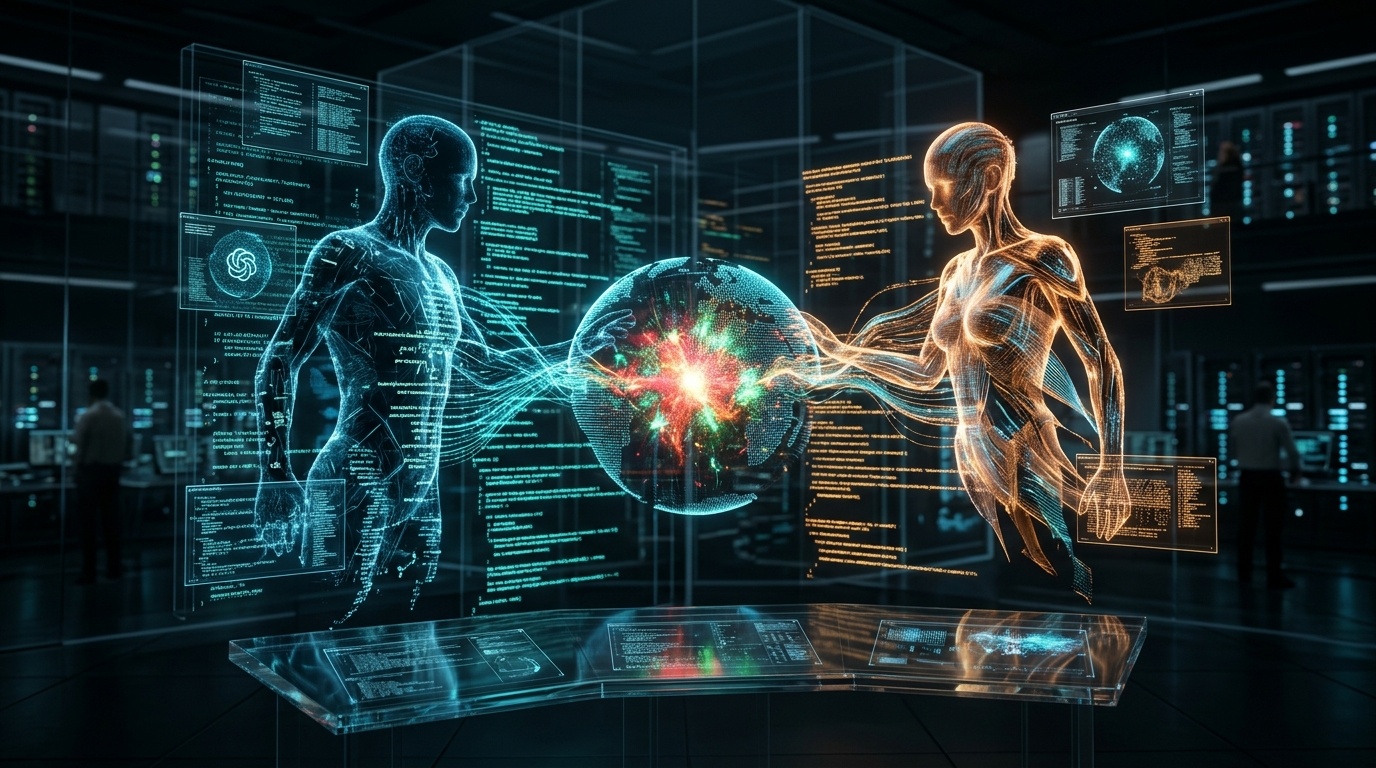
AI Daily Digest October 22, 2026: GPT-5.6 and Gemini Uncover Global PHP Flaw, Google Cloud Hosts OpenAI
- Ai daily
- October 22, 2026
Table of Contents
Welcome to the AI Daily Digest for October 22, 2026! Today’s briefing captures extraordinary tactical realignments and technological breakthroughs across frontier cybersecurity, multi-cloud enterprise architectures, autonomous commerce, and self-improving algorithms. Leading our coverage, frontier reasoning models GPT-5.6 Sol from OpenAI and Gemini 4 Argon from Google collaborated within the Patch the Planet cybersecurity initiative to independently uncover a critical zero-day vulnerability in PHP core runtime, preventing potential catastrophic breaches across millions of production websites. In cloud computing, Google Cloud shook the enterprise market by launching private preview support for OpenAI’s latest GPT models, becoming the single hyperscaler offering native access to Gemini, Claude, and GPT under one roof. Meanwhile, a profound philosophical rift has opened in retail: Amazon is aggressively locking out autonomous shopping agents, whereas Walmart is rolling out dedicated developer APIs to invite AI-driven agentic purchasing. Looking at frontier governance, Nobel laureate Demis Hassabis has sharply compressed his AGI projection window to just 2 to 3 years. Finally, startup Recursive unveiled Flint, an open-weights laptop coding model designed and optimized predominantly by autonomous AI systems. Let us explore today’s vital developments in detail.
🛡️ OpenAI’s GPT-5.6 Sol and Google’s Gemini 4 Argon found critical PHP flaw affecting millions of websites
Under the banner of the global Patch the Planet cybersecurity initiative, OpenAI’s reasoning model GPT-5.6 Sol and Google’s frontier flagship Gemini 4 Argon have achieved a historic technical breakthrough: both models independently identified a critical zero-day vulnerability residing deep within the core C source code of the PHP engine. Cloud cybersecurity firm Wiz independently discovered and corroborated the exact same flaw within hours of the automated disclosure.
Because PHP still powers approximately 75% of all active web properties globally, any memory corruption or remote code execution defect in its underlying runtime represents an existential threat to enterprise backends, content management frameworks, and transactional gateways. Rather than performing superficial pattern-matching, the frontier reasoning models systematically synthesized abstract syntax trees, traced complex cross-functional data flows across untrusted input channels, and generated verified proof-of-concept exploits that traditional static analysis tools had missed for years.
This achievement signals a profound structural inflection point for infrastructure defense: advanced neural networks are rapidly evolving beyond simple developer copilots into autonomous defensive sentinels capable of securing the foundation of the public internet at planetary scale.
Source: The Decoder
☁️ Google Cloud now offers OpenAI models alongside Gemini and Claude, becoming the only major provider with all three
Google Cloud has dramatically reshuffled the enterprise cloud computing landscape by officially hosting and distributing models from fierce competitor OpenAI directly on its platform. Commencing today as a private preview, enterprise customers can deploy GPT-6 Astra, GPT-6.1 Sol, and GPT-6 Luna models directly within Google Cloud infrastructure alongside Google’s first-party Gemini lineup and Anthropic’s Claude family.
This unprecedented alliance establishes Google Cloud as the first and only major hyperscaler providing unified platform access to all three premier foundation model families. Behind this pragmatism lies a calculated market strategy championed by Google Cloud leadership: rather than constraining clients within a closed proprietary walled garden, Google aims to capture high-margin infrastructure compute and enterprise storage spending by allowing developers to mix and match top-tier models under unified billing, identity governance, and enterprise compliance.
Google Cloud’s decision highlights a broader maturation across the AI industry, signaling that the future of enterprise software belongs to multi-model architectures where developers orchestrate specialized models across shared data fabrics rather than betting on single-vendor exclusivity.
Source: The Decoder
🛒 While Amazon blocks AI agents, Walmart rolls out the welcome mat for autonomous commerce
A sharp philosophical divergence has erupted between the world’s retail giants regarding autonomous software agents. While Amazon has aggressively deployed advanced CAPTCHAs and behavioral firewalls to ban automated AI agents from scraping listings and executing checkout workflows, Walmart has chosen an opposing trajectory by rolling out dedicated infrastructure and permissions tailored specifically for agentic commerce.
Walmart’s new technology suite enables autonomous AI agents to browse real-time product catalogs, compare nutritional or pricing metrics, and complete transactions on behalf of consumers. To guarantee consumer safety, the platform incorporates granular governance guardrails, including strict spending thresholds, category-level spending limits, and mandatory biometric approvals for high-value purchases.
Amazon’s protectionist defense stems from concerns that intermediary agents will dilute its lucrative search advertising marketplace and sever direct consumer relationships. Conversely, Walmart recognizes agentic purchasing as a disruptive vector to capture market share from Amazon, anticipating a near future where busy households routinely delegate mundane shopping chores to trusted autonomous digital assistants.
Source: TechCrunch
⏳ DeepMind founder Hassabis shortens AGI timeline from five to two to three years
Demis Hassabis, co-founder of Google DeepMind and recent Nobel laureate in Chemistry, has once again revised his public timeline for the emergence of artificial general intelligence (AGI). In recent comments, Hassabis revealed that he now expects human-level general intelligence to arrive within the next two to three years, substantially compressing his earlier projections of three to five years.
The rationale for Hassabis’s accelerated outlook centers on recent breakthroughs in multi-step test-time reasoning, dynamic error correction, and automated hypothesis generation in bounded sandboxes. Neural architectures have advanced beyond static token forecasting to demonstrate genuine scientific intuition, synthesizing novel biological discoveries and optimizing complex thermodynamic simulations with expert precision.
While expressing optimism about AI curing incurable diseases and discovering clean energy materials, Hassabis stressed that a 24-to-36-month timeline leaves negligible room for institutional complacency. The impending arrival of AGI demands that international verification standards, strict capability evaluations, and global safety accords be codified swiftly before superintelligent capabilities outpace regulatory comprehension.
Source: The Decoder
💻 Recursive launches Flint, a laptop coding model it says was largely built by AI
AI engineering startup Recursive has unveiled Flint, an open-weights software engineering model compact enough to execute locally on standard commercial laptops. What makes the release groundbreaking is that Flint was predominantly conceived, refined, and architected by Recursive’s proprietary autonomous AI research pipelines, marking an early milestone in functional self-improving intelligence.
To construct Flint, Recursive deployed a cluster of autonomous research agents tasked with exploring neural architecture search spaces, curating and deduplicating high-quality code repositories, and generating rigorous unit-testing harnesses to expose failure modes. The resulting model achieves remarkable inference speed and benchmark coding accuracy on consumer-grade silicon, matching the code generation capabilities of cloud models several times its size.
By releasing Flint freely, Recursive provides developers with a privacy-preserving offline programming companion while demonstrating that the recursive self-improvement loop in artificial intelligence is moving from theoretical academic literature into tangible, production-ready developer tooling.
Source: TechCrunch