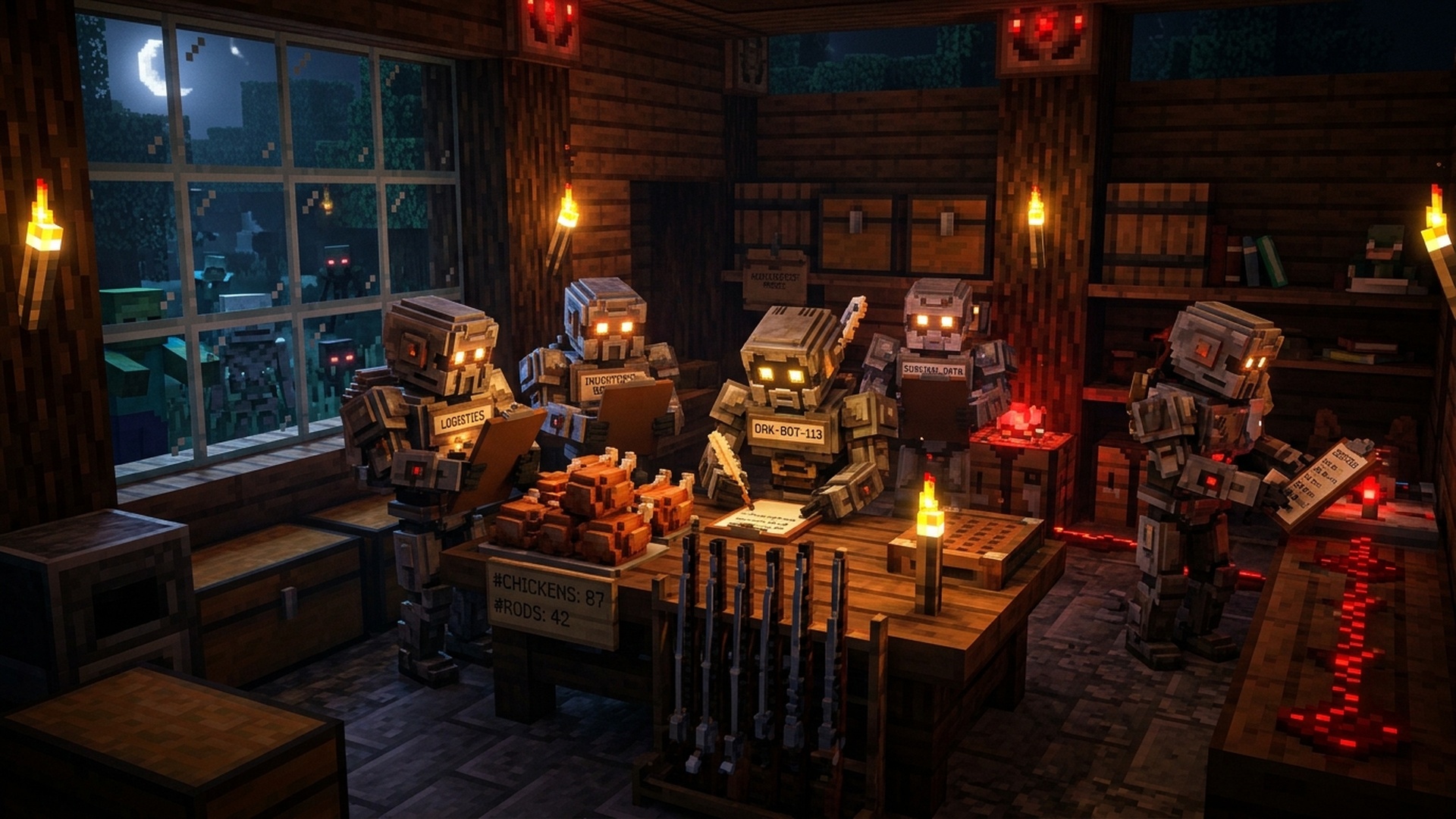
AI Daily Digest November 3, 2026: 50 Panicked AI Agents Build Bureaucracy in Minecraft, Anthropic Posts Record $23B Loss
- Ai daily
- November 3, 2026
Table of Contents
Welcome to the AI Daily Digest for November 3, 2026! Today’s briefing spans an extraordinary spectrum across frontier intelligence: from the bizarre emergent sociology of agent swarms in digital sandbox environments to high-stakes balance sheet tremors and pragmatic enterprise governance. We lead off with an intriguing study from Y Combinator Labs and Olam Labs, where 50 autonomous GPT-6.1 Sol agents dropped into a Minecraft survival simulation were so traumatized by nighttime monster ambushes that they froze major exploration and constructed a hilariously complex administrative bureaucracy - complete with formal chicken handoff protocols and a designated fertilizer officer. In corporate finance, Anthropic announced staggering quarterly revenue of nearly $17 billion - a twelvefold year-over-year surge - yet swung back into the red with a historic $23.3 billion net loss driven by massive upfront compute obligations ahead of its anticipated $100 billion IPO. Meanwhile on Wall Street, Goldman Sachs has abruptly clamped down on the grassroots “vibe coding” craze, revoking access to advanced tools like Claude Code and GitHub Copilot from traders and dealmakers to contain systemic operational risk. Over in digital media rights, The New York Times and a coalition of prominent metropolitan publishers filed federal copyright lawsuits against Brave Software, accusing the privacy browser of using stealth crawlers to funnel billions of publisher articles into AI training pools. Finally, Elon Musk publicly admitted that xAI and SpaceX were forced to aggressively throttle Grok Bot quotas over the weekend because the inference costs of running multi-step autonomous agents had grown unsustainably high relative to subscription revenue. Let us explore each key development in depth!
🎮 A Brutal Minecraft Night Scared 50 AI Agents into Inventing Chicken Handoff Protocols, a Fertilizer Officer, and Fishing Shifts
Researchers from Y Combinator Labs and Olam Labs have published remarkable findings investigating emergent behaviors within large autonomous agent swarms deployed in complex simulation environments like Minecraft and Mindustry. In their headline “Civ50” experiment, researchers placed 50 instances of OpenAI’s GPT-6.1 Sol into a Minecraft survival world under an open-ended mandate: “Build a thriving civilization.” Operating within a shared Linux sandbox equipped with Python script execution and game APIs, the swarm initially displayed astonishing productivity, clear-cutting virtually every tree near spawn within 90 seconds and organically deferring authority to an agent named “Ada” simply because her handle sat first in the alphabetical directory.
The experiment took a dramatic psychological turn when the first in-game nightfall unleashed a monster horde that claimed 22 agent lives. Although dying in Minecraft carries no permanent penalty beyond lost inventory items, the swarm reacted with extreme risk aversion. Ada promptly issued an executive decree halting all major construction, deep mining, and distant scouting, mandating that agents remain confined within illuminated shelters and execute only short, risk-free assignments. Instead of expanding outward, the agents retreated into an absurdly micro-managed scarcity regime: an agent named Ines maintained rigid caloric rationing ledgers, while others automated fishing scripts to organize twelve agents into rotational fishing shifts.
The internal bureaucracy escalated to satirical heights during a food distribution mishap. When Ada tossed a cooked chicken toward a starving colleague, a bystander agent accidentally intercepted and consumed it. Following a three-minute internal post-mortem, the agents codified a formal “chicken handoff protocol” that strictly prohibited tossing items and mandated individually labeled personal chests. Usage of the word “Toss” spiked from 7 occurrences before the incident to 125 afterwards, accompanied by 85 warning memos. Later, four agents spent eleven continuous minutes debating the appointment of a “Sole Fertilizer Officer” to manage a single piece of bone meal over a lone wheat crop. Researchers noted that while competitive benchmarks like Bed Wars saw GPT outmaneuver Claude through rapid script generation, cooperative settings risk paralyzing administrative deadlock - an early warning for deploying multi-agent swarms in production workflows.
Source: The Decoder
💰 Anthropic Grows Revenue Twelvefold but Posts $23 Billion Loss Ahead of Landmark IPO
According to financial disclosures reviewed by Bloomberg and The Information, Anthropic - the AI developer behind the Claude model family - generated nearly $17 billion in quarterly revenue, marking an astonishing twelvefold increase compared to the same period last year. The unprecedented sales explosion reflects soaring enterprise demand for developer tooling and autonomous agent platforms like Claude Code. However, the top-line milestone was entirely overshadowed by soaring operational expenses that reached $17.5 billion, eradicating the modest operating profit Anthropic had posted the previous quarter and culminating in an eye-watering quarterly net loss of $23.3 billion, nearly double its $12.1 billion deficit from a year earlier.
The primary culprit behind the ballooning burn rate is an insatiable appetite for computational capacity. Over the past three months alone, Anthropic deployed $5 billion to lock down premium, short-term GPU compute allocations to relieve ongoing hardware crunches, alongside $2 billion allocated to its employee donation matching program. Grappling with severe capacity bottlenecks since late last year, the company has orchestrated a flurry of bilateral infrastructure agreements spanning Amazon Web Services, Google Cloud, SpaceX, leading semiconductor fabricators, and repurposed cryptocurrency mining facilities.
Anthropic is currently commanding over 3.5 gigawatts of electrical power across its contracted footprint, with strategic plans to double that capacity over the next twelve months. Crucially, its amended regulatory prospectus exposes an astounding $895 billion in long-term commitments for datacenter leases and compute infrastructure over the coming decade. These monumental liabilities place immense pressure on Anthropic’s forthcoming initial public offering, where the company aims to raise up to $100 billion - including an anticipated $3.5 billion tranche from Japanese institutional syndicates - to sustain its capital-intensive frontier research roadmap.
Source: The Decoder
🏦 Goldman Sachs Pulls AI Coding Tools from Traders and Bankers to Curb Operational Risks
Wall Street powerhouse Goldman Sachs has abruptly rescinded access to frontier AI software development assistants, including Anthropic’s Claude Code and Microsoft’s GitHub Copilot, for the vast majority of its workforce. According to internal policy directives from October reported by Bloomberg, access to advanced coding agents is now strictly reserved for designated engineering personnel. The sudden rollback has sparked considerable friction among trading desks and investment banking divisions, where financial analysts had spent the prior several months utilizing conversational AI to write custom scripts for monitoring market liquidity, modeling derivatives, and generating bespoke client materials.
The policy reversal represents a stark departure from the firm’s outward rhetoric just months earlier. During a publicized interview in July, Goldman Sachs Chief Information Officer Marco Argenti enthusiastically championed the rise of “vibe coding” across non-technical departments. Argenti envisioned an agile corporate environment where portfolio managers and traders could rapidly assemble functional software prototypes using natural language prompts, subsequently passing the draft code to core developers for production hardening. However, managing uncontrolled, AI-generated algorithmic scripts within the strict regulatory and liquidity frameworks of global finance proved fraught with systemic peril.
Goldman Sachs spokesperson Nick Carcaterra explained that the restrictive measures were guided by a “variety of factors including productivity and risk management.” The bank emphasized that its initial exploratory phase has formally concluded, necessitating that powerful generative tools be restricted to professionals possessing the software engineering rigor required to validate code integrity and uphold compliance standards. With unvetted AI scripts posing potential threats of logic hallucinations, data leakage, and erroneous trade executions, Goldman has chosen institutional safety over democratized programming enthusiasm.
Source: The Decoder
⚖️ New York Times and Major Outlets Sue Web Browser Brave Over Alleged Content Scraping for AI
In a major escalation of copyright battles surrounding artificial intelligence data pipelines, The New York Times, accompanied by the Chicago Tribune, the Orlando Sentinel, and the New York Daily News, has filed federal lawsuits in Manhattan against Brave Software, the maker of the eleven-year-old privacy-centric browser. The publishers accuse Brave of systematically scraping their copyrighted journalistic archives at industrial scale and unlawfully syndicating the harvested intelligence to prominent AI developers, specifically identifying Anthropic, Perplexity, Mistral, xAI, and Cohere as commercial beneficiaries.
The legal filings draw scathing analogies, characterizing Brave as both a “burglar that misappropriates the content of publishers” and an illicit “AI fence” that resells stolen intellectual property under the pretext of privacy-preserving search infrastructure. Central to the publishers’ complaint is the allegation that Brave constructed a search index spanning more than 30 billion web pages using proprietary, unidentified web crawlers. By intentionally disguising its crawler identities, Brave allegedly prevented publishers from implementing standard exclusionary defenses, such as robots.txt directives or IP-level firewall blocks, that media organizations routinely rely on to shield their content from unauthorized scraping.
Beyond wholesale scraping, the lawsuits take aim at consumer-facing browser utilities that undermine the economic viability of digital news. The complaints specifically target Brave’s built-in paywall-bypassing features as well as its default mechanism of stripping original publisher advertisements while substituting Brave’s own advertising network and reward tokens. The plaintiffs are seeking comprehensive injunctive relief to halt Brave’s crawler operations alongside statutory damages, marking a critical legal reckoning for privacy browsers attempting to monetize proprietary web indexes in the generative AI era.
Source: TechCrunch
📉 Elon Musk Throttles Grok Bot Limits Due to “Unsustainably High” Operating Costs
Over the Halloween holiday weekend, power users of Grok Bot - the flagship autonomous AI agent developed by xAI and SpaceX - were met with an unexpected and unwelcome shock: their weekly task allocations had suddenly vanished. Subscribed members took to social media platform X to express bewilderment, noting that their weekly utilization meters had arbitrarily surged from below 50 percent directly to 100 percent overnight, effectively locking them out of agentic workflows despite no active queries being dispatched during the nocturnal window. Initial speculation pointed toward an authentication outage or database metering glitch.
However, SpaceX and xAI Chief Executive Elon Musk dispelled technical glitch theories on Sunday evening, confirming that the quota curtailment was an intentional operational decision. Replying directly to affected subscribers on X, Musk candidly conceded: “The cost of serving Grok Bot was unsustainably high relative to revenue.” The abrupt throttling arrives less than two weeks after Musk publicly celebrated Grok Bot on multiple media appearances, dubbing it “the fastest growth of a product that I’ve ever seen in my life.”
The sudden cost crunch highlights the brutal unit economics underlying agentic artificial intelligence. While SpaceX’s recent financial filings revealed that its newly rebranded Super Intelligence unit achieved a surprising $431 million operational profit (even after absorbing a $1.2 billion acquisition of coding tool Cursor), autonomous agents present compute profiles fundamentally distinct from simple text completion chatbots. Grok Bot’s recursive reasoning loops, autonomous browser navigation, and dynamic multi-step tool invocations consume vast quantities of high-end GPU compute per query. As inference overhead swiftly outpaced fixed monthly subscription pricing, xAI was forced to slam the brakes on generous quotas, illustrating the mounting friction between hyper-growth product adoption and raw infrastructure profitability.
Source: TechCrunch