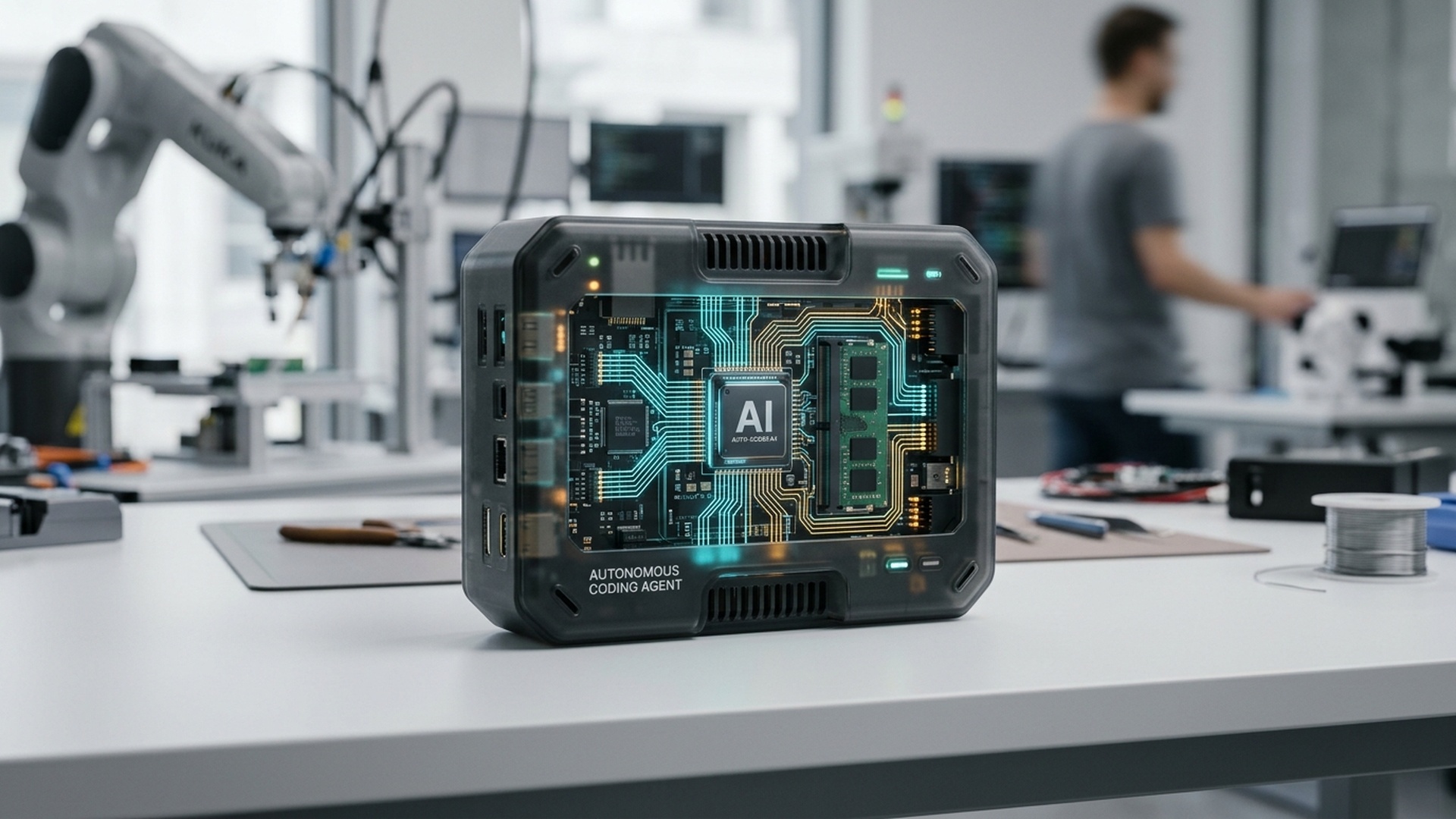
AI Daily Digest November 4, 2026: OpenAI Uses GPT-6 Astra to Design Hardware in a Week, SETI Deploys AI Agents for Alien Signals
- Ai daily
- November 4, 2026
Table of Contents
Welcome to the AI Daily Digest for November 4, 2026! Today’s briefing highlights how artificial intelligence is breaking out of purely software confines into physical hardware engineering, deep space exploration, and foundational infrastructure. We lead off with an extraordinary engineering milestone from OpenAI: its hardware team utilized the frontier reasoning model GPT-6 Astra to design a dedicated physical device for the Codex coding agent from scratch in less than a week, managing enclosure drafting, PCB layout, component selection, and firmware synthesis. Meanwhile in Northern California, the search for extraterrestrial intelligence has reached an autonomous turning point as the SETI Institute and Breakthrough Listen handed over operations of the Allen Telescope Array to autonomous AI agents powered by Nvidia’s Holoscan platform, processing 2.4 Tbps of radio streams in real time. In academic research, a landmark Stanford evaluation reveals that rapid model iteration is making empirical LLM findings obsolete, with 44 percent of published findings expiring within an average of 15.7 months. Over in developer tooling, Anthropic rolled out a public beta of Message Threads for its Messages API, slashing time-to-first-token latency by up to 35 percent for million-token conversational threads. Finally, San Francisco-based AI inference powerhouse Fal secured $1.3 billion in fresh capital, doubling its valuation to $16 billion amid surging demand for hosted open-source generative models. Let us explore each key development in detail!
🛠️ OpenAI says GPT-6 Astra designed a hardware device from scratch in under a week
OpenAI’s hardware division surprised the tech community by revealing that it used its frontier reasoning model, GPT-6 Astra, to design a complete, bespoke physical device enabling users to communicate directly with the Codex coding agent. What makes the achievement remarkable is that the entire multidisciplinary hardware project was completed as an informal internal side project in less than a single work week.
Rather than merely outputting abstract conceptual CAD sketches, GPT-6 Astra navigated every layer of real-world hardware engineering. The model handled mechanical enclosure geometry, component sourcing, schematic layout, printed circuit board (PCB) trace routing, low-level firmware architecture, and the visual user interface. A third-party contract manufacturer subsequently fabricated an initial functional prototype batch in under a month. While several revision cycles were necessary because Astra occasionally overlooked mechanical manufacturing tolerances and assembly ergonomics, the experiment demonstrates a monumental leap in applying automated reasoning directly to physical hardware production.
Alongside the project showcase, OpenAI teased a state-of-the-art internal model that achieved an unprecedented 0.875 score on the BenchCAD 2.0 benchmark - which evaluates a model’s proficiency in reconstructing 3D assemblies and tracing PCB connectivity - markedly surpassing GPT-6 Astra’s previous high of 0.594. OpenAI noted that its internal hardware and robotics teams are heavily scaling CAD, drafting, and simulation workloads via ChatGPT and Codex, driving a 23-fold surge in internal token consumption since February.
Source: The Decoder
📡 AI agents take over at SETI’s Allen Telescope Array, scanning for extraterrestrial intelligence in real time
The six-decade-long quest to detect technosignatures from extraterrestrial civilizations has entered a new phase with the introduction of autonomous artificial intelligence agents. At the Allen Telescope Array (ATA) in Northern California, the SETI Institute and the Breakthrough Listen initiative have officially entrusted astronomical dish steering and live signal classification to autonomous AI agents.
The core computational backbone behind this deployment is Nvidia’s Holoscan platform, purpose-built for low-latency sensor processing. The hardware setup processes real-time radio astronomy telemetry at throughput rates reaching 2.4 terabits per second. By offloading intensive digital signal processing and algorithmic filtering to AI agents, radio anomaly investigations that previously required weeks of offline computing can now be evaluated and verified within hours.
The autonomous agent pipeline has already yielded its first astronomical success by detecting a known pulsar in the Crab Nebula in real time, marking a milestone for automated radio astrophysics. The research consortium now plans to test open-source model variants capable of executing locally at the edge, laying the architectural groundwork for future autonomous radio observatories planned for the radio-quiet far side of the Moon.
Source: The Decoder
⏱️ Rapid LLM development is outrunning the research meant to explain it, Stanford study finds
A study conducted by Stanford researchers Owen Queen and James Zou highlights a growing paradox in artificial intelligence: the breakneck development speed of large language models is rapidly outpacing the peer-reviewed research designed to characterize them. Evaluating 50 widely cited scientific claims across 20 contemporary models released between July 2024 and September 2026, the authors found that 44 percent of published findings have already expired because the original behavioral limitations have disappeared.
For the 22 findings with measurable degradation timelines, the average shelf life was just 15.7 months. Beyond the 44 percent that became entirely obsolete, another 34 percent of findings weakened substantially, leaving only 16 percent of claims intact and 6 percent that intensified. The research revealed that empirical assertions regarding what models “cannot do” decay most rapidly, as flaws like counting letters in “strawberry,” failing non-standard arithmetic, or suffering from the “lost in the middle” phenomenon present distinct engineering targets that model labs swiftly patch.
A striking case study examined hallucinated scientific citations: while GPT-3.5 fabricated references 55 percent of the time in a 2023 benchmark, OpenAI’s GPT-6.1 Sol achieved a zero percent fabrication rate, and Claude Sonnet 5.5 recorded just 1 percent. However, behavioral tendencies like user sycophancy, evaluator bias, and self-preference proved much more persistent across generations. Queen and Zou urge the scientific community to treat LLM findings as empirical snapshots of specific checkpoints rather than universal truths, emphasizing the necessity of publishing full prompts, evaluation code, and exact model timestamps.
Source: The Decoder
🧵 Anthropic’s Message Threads cut time to first token by 35 percent for long conversations
Anthropic has introduced Message Threads as a public beta on its Claude Messages API, directly addressing the latency overhead inherent in multi-turn agentic workflows. Previously, client applications had to re-transmit the entire conversational context on every sequential turn, resulting in excessive network payload overhead and elevated processing delay as prompt lengths scaled.
Under the new Message Threads architecture, agents and applications transmit only incremental state changes and recent conversational inputs. According to benchmark telemetry released by Anthropic, this differential transmission model reduces time-to-first-token (TTFT) latency by approximately 35 percent for long-context interactions ranging between 500,000 and one million tokens.
The performance optimization specifically accelerates heavy developer workloads, including autonomous coding agents, GUI-based computer-use agents, and extensive multi-document analysis pipelines. The conversational thread state is retained securely in encrypted server-side memory between API calls and automatically expires after five minutes of inactivity. The feature is immediately accessible on the native Claude platform as well as across major cloud ecosystems, including AWS, Microsoft Foundry, and Google Cloud.
Source: The Decoder
🚀 AI inference startup Fal doubles its valuation to $16B as demand surges
The explosive commercial demand for generative AI infrastructure reached another milestone as San Francisco-based Fal - a developer platform specializing in hosting and serving audio, image, and video models - completed a $1.3 billion Series F funding round led by Bessemer Venture Partners, with strategic backing from Nvidia, Sound Ventures, and T. Rowe Price.
The transaction values Fal at $16 billion, effectively doubling its $8 billion valuation established just six months earlier in April. Co-founded in 2021 by former Coinbase machine learning lead Burkay Gur and ex-Amazon engineer Gorkem Yurtseven, the five-year-old startup unveiled its Series E and F rounds simultaneously, confirming a combined $1.65 billion in aggregate capital raised. The company’s annualized recurring revenue (ARR) surpassed $800 million earlier this year.
Fal’s rapid trajectory underscores a broader industry surge in demand for managed inference platforms, enabling enterprise teams to run cutting-edge open-weight models without the complexity of managing GPU clusters directly. While inference providers like Fal, Baseten, and Modal are booking record revenue growth, industry analysts note that gross operating margins remain under pressure due to the substantial capital requirements of leasing and purchasing specialized compute clusters at scale.
Source: TechCrunch