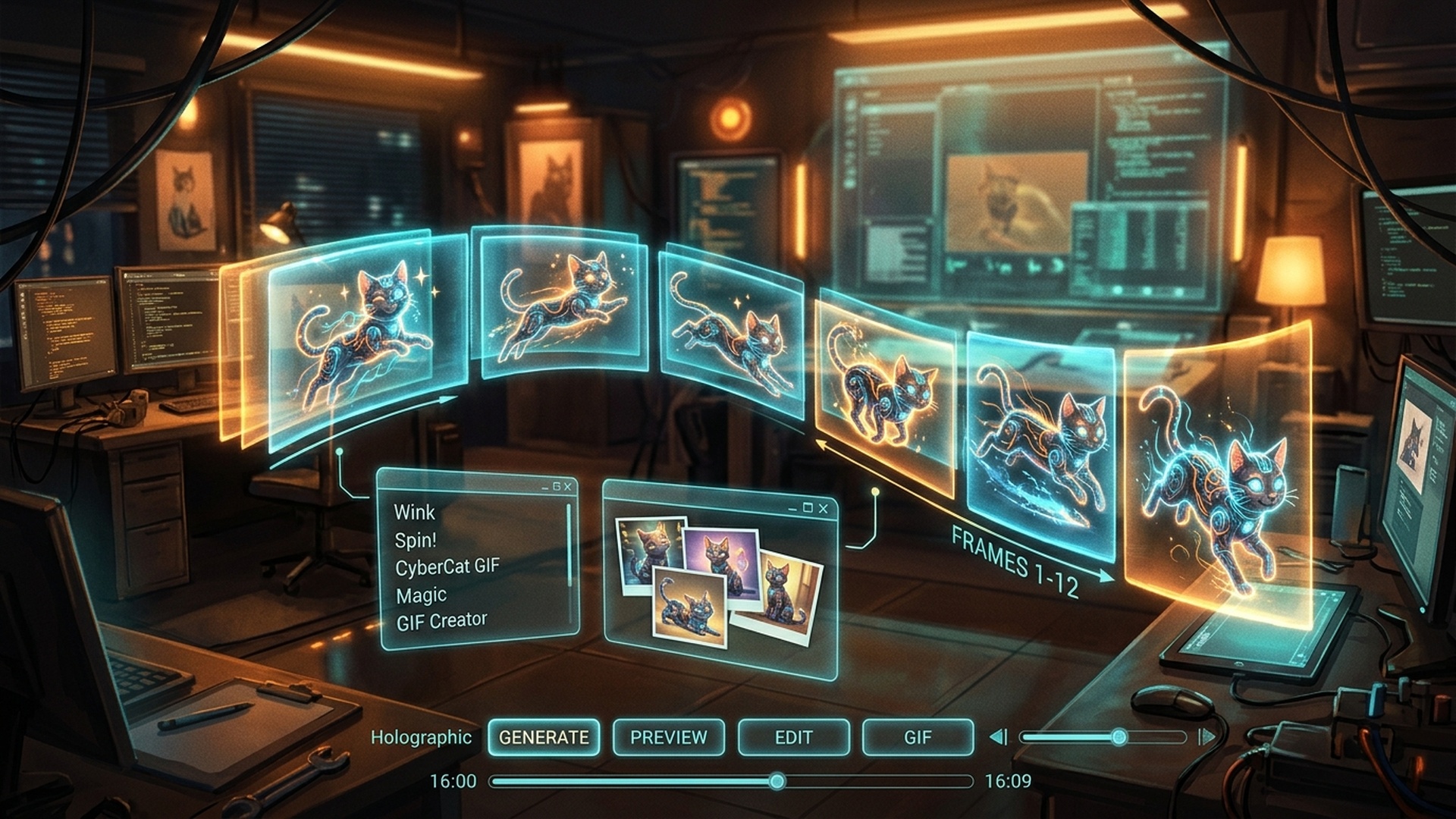
AI Daily Digest November 5, 2026: ChatGPT Generates Animated GIFs, Uber Reveals Only 4 Rides Booked via AI Agents
- Ai daily
- November 5, 2026
Table of Contents
Welcome to the AI Daily Digest for November 5, 2026! Today’s briefing explores the contrasting dynamics of the artificial intelligence ecosystem: from creative breakthroughs reaching hundreds of millions of everyday users to sobering commercial realities and high-stakes infrastructure acquisitions. We kick off with an exciting feature rollout on ChatGPT: OpenAI has introduced animated GIF generation powered by its frontier Images 2.6 model, enabling web, desktop, and mobile users to craft and edit animated clips from text prompts or personal photos with remarkable character consistency across frames. In stark contrast to the consumer hype surrounding autonomous agents, Uber’s latest quarterly earnings disclosure delivered an unexpected reality check, revealing that during its busiest Halloween week of 320 million transactions, only 4 rides and 500 food orders were booked through personal AI agents. Over in developer ecosystems, competition for agentic programming infrastructure is intensifying rapidly: OpenAI has acquired Pierre Computer Company to build next-generation Git primitives alongside its Pando version control system for Codex, while Meta finalized its purchase of Conductor to bring multi-agent parallel workspaces into its Superintelligence Labs. Finally, technical revelations around AI compliance emerged as Anthropic disclosed that its incoming EU-mandated text watermarks can be completely bypassed on older Claude models simply by tweaking standard API sampling parameters. Let us delve into each key development in detail!
🎬 ChatGPT can now create animated GIFs and edit individual frames with OpenAI’s Images 2.6 model
OpenAI has officially launched animated GIF generation across ChatGPT and the Codex coding interface, rolling out the visual capability to all global web, desktop, and mobile subscribers. The feature is powered by the company’s newly deployed Images 2.6 model architecture. Moving beyond static visual synthesis, the new workflow allows creators to generate dynamic animations from descriptive text prompts or uploaded photographs, while providing fine-grained controls to adjust playback speed or modify individual animation frames.
In demonstration tests, OpenAI showcased how a prompt like asking for a dancing cat generates several sequential visual variations that are assembled flipbook-style into a cohesive GIF. A historically persistent challenge in diffusion-based generative imagery has been maintaining cross-frame identity and stylistic consistency, with subjects frequently morphing or changing clothing between micro-steps. Images 2.6 demonstrates substantial progress in character persistence, keeping key anatomical features and visual landmarks recognizable across sequential motions.
Alongside the consumer-facing GIF tool, Images 2.6 delivers broad speed optimizations across standard image generation tasks. For enterprise developers, OpenAI concurrently introduced two API model checkpoints: GPT-Image-2.6 “Flare” for low-latency cost-effective throughput, and “Sunburst” for photorealistic creative fidelity. OpenAI revealed that users are now generating more than four billion images per week across ChatGPT and developer APIs, marking an increase of one billion weekly images compared to September metrics.
Source: The Decoder
🚗 Almost no one uses AI agents to book their Uber, company earnings call reveals
The intense industry enthusiasm surrounding autonomous personal AI agents has run into a striking consumer reality check. During Uber’s third-quarter earnings conference call, corporate leadership shared surprising transactional metrics regarding the real-world adoption of agentic services: during the final week of October, the platform’s busiest operational period of the quarter encompassing Halloween festivities, exactly four rides were booked through personal AI agents across the entire global network. The company’s food delivery arm, Uber Eats, recorded approximately 500 agent-initiated orders during the same window.
To place those figures into proper operational context, Chief Financial Officer Balaji Krishnamurthy noted that Uber managed roughly 320 million completed trips and delivery orders during that single week. Chief Executive Officer Dara Khosrowshahi acknowledged the early stage of autonomous workflows, observing that consumer traction remains exceptionally limited. Khosrowshahi pointed out that hailing a ride on the native mobile app requires an average of just 50 seconds, while reordering a favorite meal takes roughly 90 seconds. With existing consumer mobile interfaces refined for minimal friction, delegating errands to conversational agents currently offers negligible time savings for everyday users.
The subdued engagement numbers align closely with disclosures from delivery rival DoorDash, which confirmed on its recent earnings call that it had received only several hundred agent-driven orders to date. Even as autonomous assistant startups like Instinct secure multibillion-dollar valuations and tech conglomerates race to embed agents into text messaging channels, early commercial indicators suggest the transition toward an autonomous agentic web will require substantial behavioral shifts before matching existing application convenience.
Source: TechCrunch
🐙 OpenAI acquires Pierre Computer Company to overhaul Git workflows for AI coding agents
OpenAI has announced the strategic acquisition of Pierre Computer Company, the startup behind Code Storage and several foundational open-source developer libraries that already power the Codex autonomous programming agent. Pierre’s core tooling portfolio includes “Trees” for rapid filesystem graph traversal, “Diffs” for interactive visual patch inspection and in-line debugging, and “Highlights”, a real-time syntax highlighting engine designed to process streaming code output as models generate tokens.
The core motivation behind the acquisition centers on modernizing version control architectures as software engineering becomes increasingly agentic. Traditional Git workflows were originally engineered around human collaboration cadences: asynchronous branches, deliberate manual commits, and sporadic pull request reviews. However, when multiple autonomous agents write and execute code in parallel alongside human engineers, legacy version control primitives frequently bottleneck on merge conflicts, rebase friction, and synchronization latency.
OpenAI previously introduced Pando, its proprietary version control backend designed specifically to scale concurrent developer and agent workflows. By uniting Pierre’s interface libraries and code visualization primitives with Pando’s backend infrastructure, OpenAI aims to build a cohesive developer environment where human engineers and autonomous agents collaborate seamlessly. OpenAI confirmed that all of Pierre’s existing open-source software libraries will remain open to the public developer community following regulatory approval.
Source: The Decoder
🤖 Meta acquires AI coding startup Conductor to scale multi-agent parallel workspaces
Meta has continued its aggressive acquisition strategy in software development infrastructure by buying Conductor, an artificial intelligence startup specializing in orchestrating autonomous agent teams across isolated project workspaces. Founded in 2024 by Charlie Holtz, Conductor built a collaborative platform that enables software engineers to spin up compartmentalized agent teams that tackle independent components of a codebase simultaneously across cloud instances, local machines, or mobile interfaces.
Following the acquisition, Holtz and the Conductor engineering team will integrate directly into Meta’s Superintelligence Labs (MSL), working alongside Chief AI Officer Alexandr Wang and Product Head Nat Friedman. Conductor announced that its standalone commercial cloud service will sunset on November 20, as the team shifts focus toward building next-generation developer interfaces planned for release early next year. While Conductor previously deployed external frontier models from Anthropic and OpenAI, the acquisition allows Meta to tightly couple the multi-agent orchestrator with its own frontier model stack.
The transaction highlights Meta’s determined push to establish leadership in AI developer tooling after historically trailing dedicated coding assistants. Following the summer release of its specialized Muse Code assistant and rapid consumer adoption of its Muse platform - which surpassed 10 million downloads in just 40 days - incorporating Conductor’s multi-agent coordination capabilities positions Meta to compete directly against enterprise developer platforms like GitHub Copilot Workspace and OpenAI Codex.
Source: TechCrunch
🛡️ Anthropic’s text watermark is easy to bypass on several older Claude models
Anthropic is expanding cryptographic text watermarks across several older Claude model families in preparation for the compliance deadline of the European Union AI Act arriving this December. In a recent advisory issued to API developers, the company confirmed that text watermarking is being retrofitted to Claude Opus 4.6, Claude Opus 4.5, Claude Sonnet 4.5, and Claude Haiku 4.5. The watermarking mechanism embeds an imperceptible statistical pattern into model word selection probabilities, allowing automated verification without altering text semantics or inflating token costs.
However, the disclosure revealed a notable architectural loophole on legacy checkpoints: on models such as Claude Opus 4.6 and Claude Sonnet 4.6, the watermark algorithm only activates when developers keep all three primary sampling parameters - temperature, top_p, and top_k - set strictly to their factory defaults. If an API user introduces even a fractional variation to any single sampling parameter, the watermark is completely omitted from the generated text output, rendering the statistical identifier undetectable.
The loophole is particularly consequential because Claude Opus 4.6 remains widely regarded across developer communities as Anthropic’s premier creative and long-form writing model, outperforming even newer architectures like Opus 5.5 in stylistic depth. The discovery highlights persistent engineering challenges in enforcing machine-verifiable watermarks across flexible generative interfaces, illustrating the complex trade-offs between regulatory provenance mandates and developer parameter customization.
Source: The Decoder