AI Daily Digest November 12, 2026: Anthropic Uses AI to Breach Nvidia's CUDA Moat, DeepMind Verifies Signal's Cryptography
- Ai daily
- November 12, 2026
Table of Contents
Welcome to the AI Daily Digest for November 12, 2026! Today’s briefing spotlights landmark shifts across foundational computing infrastructure, software verification, and enterprise market dynamics. Taking center stage is Anthropic, which disclosed in an investor presentation that it used its in-house frontier AI model Mythos to write and port GPU kernels for AMD accelerators in merely three days - striking a direct blow against Nvidia’s long-standing CUDA software monopoly. In cybersecurity, Google DeepMind achieved a remarkable milestone as AlphaProof Code formally proved the mathematical correctness of Signal’s active cryptographic core in four weeks, compressing years of specialized human labor. Complementing this breakthrough, Google launched Gemini Decision 1, a dedicated API designed to score up to 1,000 closed-ended decisions in milliseconds without generating wasteful conversational prose. Hardware innovation also gathered momentum in the UK, where startup Fractile secured $720 million to scale DRAM-stacked chips tailored specifically for agentic AI workloads. Finally, financial analytics from the Ramp AI Index uncover the stark reality of corporate AI adoption: while total spending touched record highs, monthly growth decelerated to 1.65%, with a minuscule top tier of 1% of enterprises funding 80% of major AI vendor revenues. Let us explore today’s five pivotal technology stories in detail!
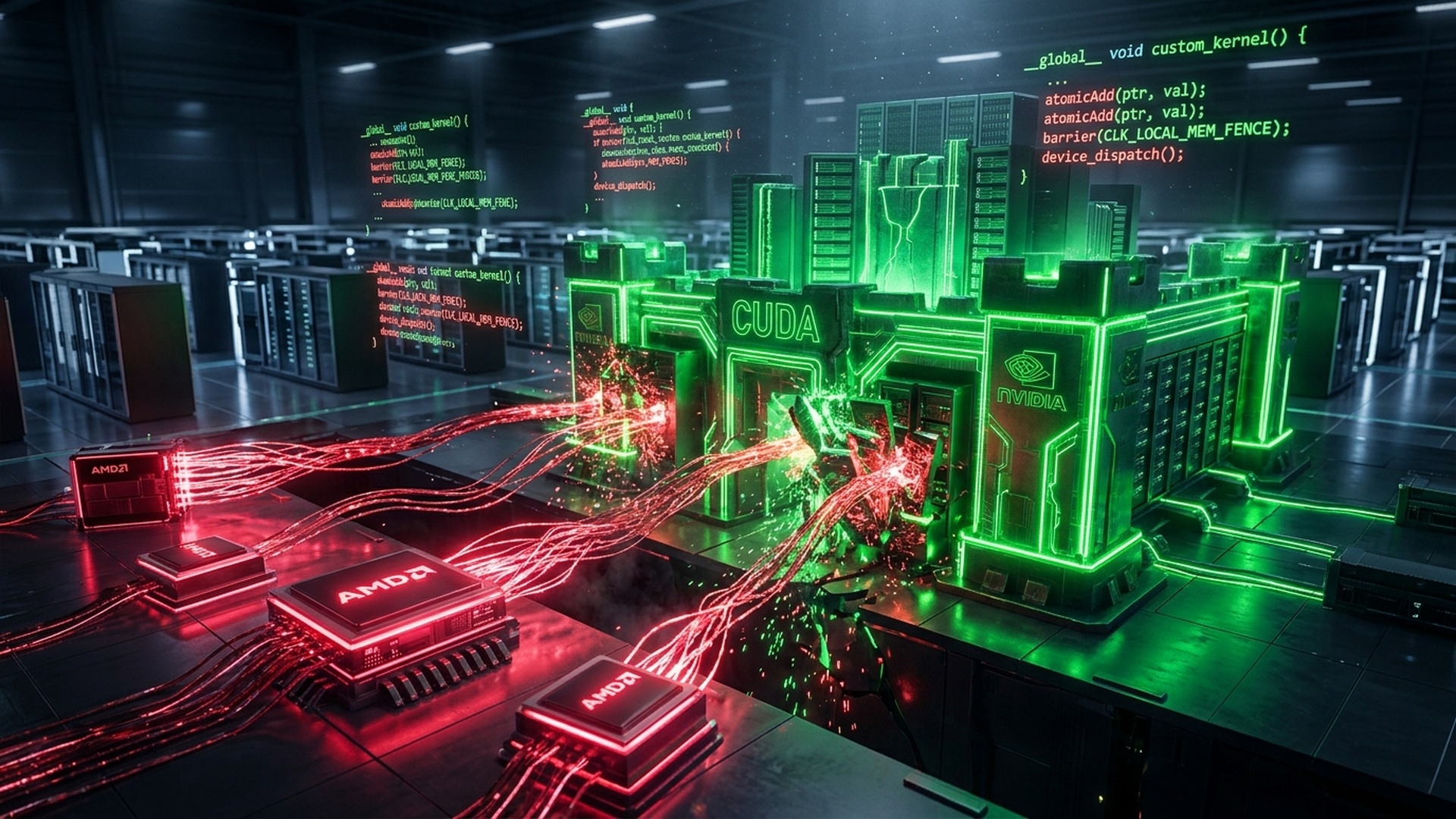
⚔️ Anthropic uses AI to breach Nvidia’s CUDA moat, cutting AMD chip switch to three days
In an investor presentation ahead of its historic public listing, Anthropic revealed a technical breakthrough that could redefine the economics of semiconductor computing. For nearly two decades, Nvidia’s dominant competitive moat has relied not just on raw hardware performance, but on its pervasive CUDA software ecosystem - a layer that traditionally required six to twelve months of engineering effort to port frontier models to alternative architectures like AMD.
Anthropic claims it has effectively dismantled this barrier using artificial intelligence itself. When onboarding AMD Instinct MI355X accelerators for the first time this year, Anthropic tasked its proprietary frontier model Mythos with kernel generation and porting. The results proved astonishing: in just three days and with virtually zero manual human intervention, Mythos wrote or adapted nearly 100 percent of the execution kernels, bringing Claude to operational speed on AMD hardware.
Co-founder and Chief Compute Officer Tom Brown explained that Anthropic now trains and runs Claude across four major hardware platforms: AWS Trainium, Google TPUs, Nvidia GPUs, and AMD GPUs. Compute from all vendors is managed as a single fungible resource pool. By driving the software migration cost near zero through automated AI translation, Anthropic threatens Nvidia’s lucrative 70-plus percent gross margins, empowering frontier labs to dynamically route compute workloads to the most cost-effective silicon available.
Source: The Decoder
🔐 DeepMind’s AlphaProof Code mathematically verifies Signal’s cryptographic core in four weeks
Google DeepMind has introduced AlphaProof Code, an artificial intelligence framework engineered to mathematically verify that production software strictly conforms to formal security specifications without defects. Demonstrating the system under real-world conditions, DeepMind partnered with the Signal Foundation to evaluate the exact cryptographic core code executing on user devices across the messaging service.
Historically, formal mathematical verification was largely confined to high-level theoretical protocol designs due to the prohibitive human labor required to construct formal proofs for production code. Utilizing AlphaProof Code, autonomous AI agents powered by Gemini Carbon generated over six million lines of formal proof script written in the Lean language. The entire verification initiative concluded in just four weeks, a milestone that would typically require years of manual proof engineering.
The AI framework formally verified the overwhelming majority of the cryptographic codebase, flagging approximately one percent of specialized sections for human specialist inspection. To rigorously validate the system’s vigilance, researchers deliberately introduced two subtle security flaws into the source code; AlphaProof Code identified both anomalies immediately. Signal Chief Technology Officer Ehren Kret emphasized that automated formal verification provides unprecedented privacy assurance amidst escalating cyber threats.
Source: The Decoder
⚡ Google debuts Gemini Decision 1: Scoring 1,000 decisions simultaneously in 200 milliseconds
Google DeepMind has officially commercialized the Gemini Decisions API powered by its novel Gemini Decision 1 model. Diverging from conventional autoregressive language models that generate prose token by token, Gemini Decision 1 is purpose-built for rapid, closed-ended evaluations: binary yes/no questions, categorical multiple-choice selections, and continuous scale-based ratings.
The architectural distinction lies in extreme parallel evaluation: the model evaluates up to 1,000 independent questions in a single computational pass across text, imagery, audio feeds, video streams, and PDF files. Rather than generating textual justifications, it directly returns probability distributions and calibrated confidence scores within 150 to 250 milliseconds. Google disclosed that it already relies on the engine internally for dynamic agent dispatch in Gemini Notebook, search integrity checks, and user interface synthesis within Stitch.
From a cost perspective, the Gemini Decisions API introduces aggressive pricing: $0.10 per million input tokens with zero output-token fees, making it five times cheaper than Gemini 3.5 Flash-Lite. This specialized paradigm offers an ultra-efficient primitive for multi-agent workflows requiring instantaneous branching decisions without incurring the latency or financial penalties of full-scale language models.
Source: The Decoder
💾 British startup Fractile raises $720M at $7B valuation to build memory-optimized chips for AI agents
Semiconductor startup Fractile has finalized a $720 million Series C financing round, valuing the British chip venture at over $7 billion (surpassing 5 billion pounds). The capital infusion received anchor support from the UK Sovereign AI Fund alongside prominent Silicon Valley venture firms, including Thrive Capital, Founders Fund, Lightspeed Venture Partners, and Redpoint.
While incumbent GPUs prioritize dense floating-point matrix arithmetic, Fractile’s architecture targets the critical structural bottleneck hindering autonomous AI agents: memory bandwidth. As intelligent agents execute extended multi-step reasoning trajectories and continuous tool calls, execution speed frequently stalls while shunting weights between processors and external memory. Fractile circumvents this physical constraint by vertically stacking DRAM memory directly atop the compute silicon, dramatically enhancing bandwidth while preserving necessary capacity.
Complementing its hardware architecture, Fractile provides a proprietary full-stack machine learning compiler engineered to maximize large language model execution speed. Founder and Chief Executive Walter Goodwin confirmed that the newly secured capital will finance production scaling, enabling Fractile to deliver its inaugural commercial hardware systems to enterprise customers next year.
Source: TechCrunch
📊 US corporate AI spending hits record high, but 1 percent of firms drive 80 percent of revenue
The November 2026 edition of the Ramp AI Index, aggregating transaction telemetry from over 85,000 American corporate entities, reveals sobering dynamics behind commercial artificial intelligence adoption. Although aggregate enterprise investment in AI services reached an all-time peak in October, month-over-month growth cooled noticeably to 1.65 percent.
Beneath the modest aggregate expansion lies extreme concentration governed by a classic Pareto distribution. Approximately one percent of enterprise customers generate eighty percent of all enterprise revenue for market leaders OpenAI and Anthropic. Within this top tier - predominantly venture-backed technology, financial services, and engineering firms - monthly AI expenditure averaged a massive $10,200 per employee, climbing 9 percent. In stark contrast, median spending across the remaining ninety-nine percent hovered at just $16.32 per worker.
Departmentally, software development organizations remain the primary spenders, absorbing 72 percent of total token allocations. However, customer service departments posted the most rapid growth trajectory, expanding their expenditure share from 0.8 percent in June to 13.3 percent in October. Meanwhile, average token prices fell 21 percent over the month, illustrating how intense provider competition continues to squeeze unit margins.
Source: The Decoder